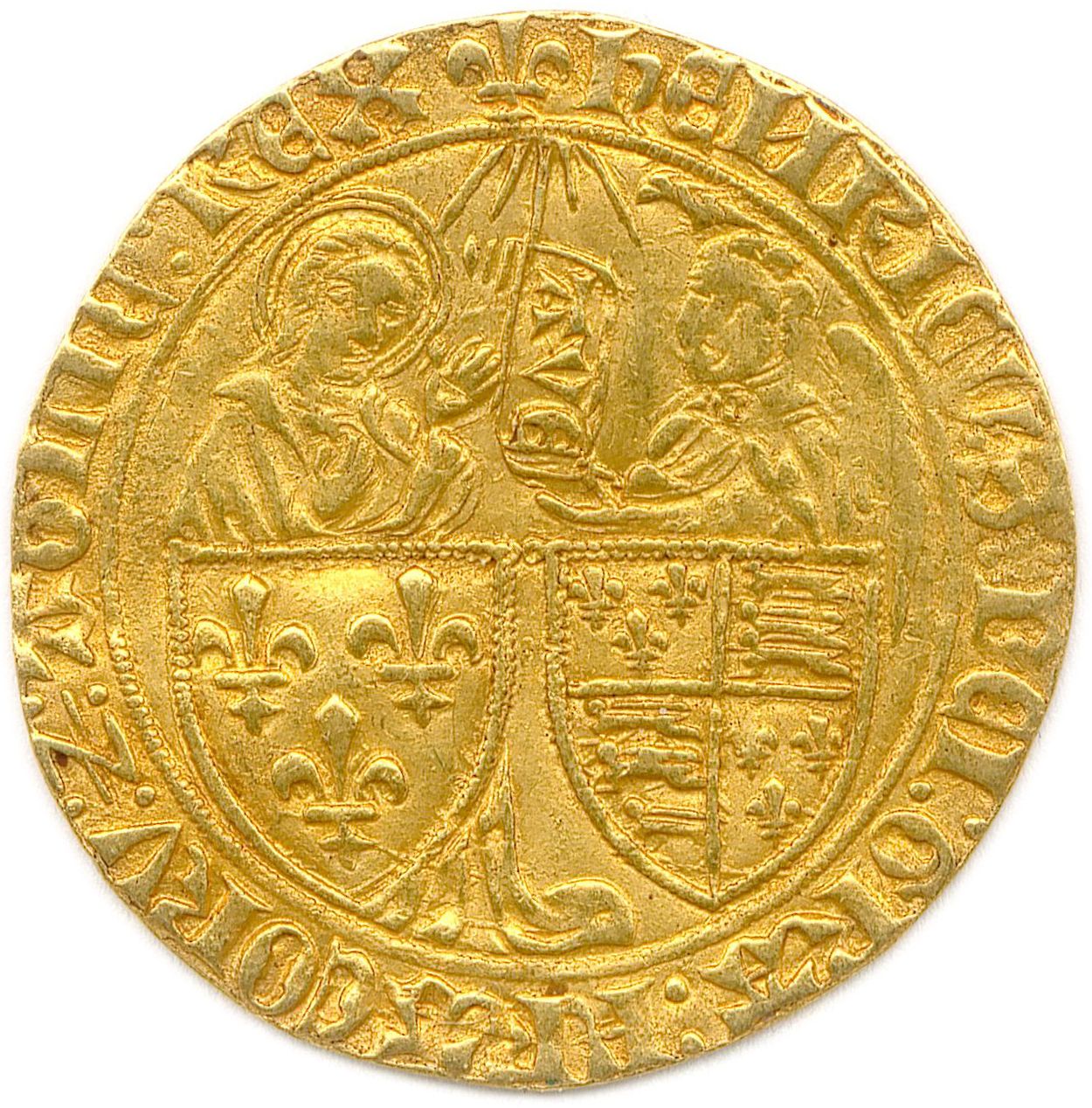
HENRY VI, King of France and England (October 21, 1422 – October 19, 1453). (⚜) HENRICVS: DEI: GRA: FRACORV: Z: AGLIE: REX. Behind the coats of arms of France and England, the Archangel Gabriel stands facing the Virgin Mary, to whom he extends a scroll bearing the descending word AVE. Above, divine light. R/. (⚜) XPC' * VINCIT' * XPC' * REGNAT' * XPC' * IMPERAT. A Latin cross between a lily and a leopard. An “H” at the base and a fleur-de-lis-patterned polylobe border. Dy 443. Gold Salut (2nd issue, September 6, 1423). Lily = Saint-Lô (weight: 3.11 g). T.B. Note: Henry VI was born on December 6, 1421, at Windsor Castle and died on May 21, 1471, as a prisoner in the Tower of London. He was the son of King Henry V of England and the grandson of King Charles VI of France. Having become king at the age of one, Henry VI reigned until 1437 under the regency of his uncles John and Humphrey of Lancaster. His personal reign was marked by the end of the Hundred Years’ War (1337–1453) and the beginning of the War of the Roses between the House of Lancaster and the House of York (1455–1485), two branches of the House of Plantagenet. It was through the Treaty of Troyes (1420) that Henry was proclaimed King of France in 1422. This treaty, concluded between Henry V and Charles VI, made Henry V the son-in-law and successor of Charles VI. The King of England, victorious at Agincourt in 1415, had been allied since 1419 with Philip the Good, Duke of Burgundy, who led the powerful Burgundian faction. Since Henry V died before Charles VI, the French crown passed to Henry V. Expert: Ms. Françoise BERTHELOT-VINCHON
Estimate
€1,000 - €1,200
Result
€1,200
Buyer's premium
28.8%
HENRY VI, King of France and England (October 21, 1422 – October 19, 1453).
(⚜) HENRICVS: DEI: GRA: FRACORV: Z: AGLIE: REX. Behind the coats of arms of France and England, the Archangel Gabriel stands facing the Virgin Mary, to whom he extends a scroll bearing the descending word AVE. Above, divine light.
R/. (⚜) XPC' * VINCIT' * XPC' * REGNAT' * XPC' * IMPERAT. A Latin cross between a lily and a leopard. An “H” at the base and a fleur-de-lis-patterned polylobe border. Dy 443.
Gold Salut (2nd issue, September 6, 1423).
Lily = Saint-Lô (weight: 3.11 g).
T.B.
Note: Henry VI was born on December 6, 1421, at Windsor Castle and died on May 21, 1471, as a prisoner in the Tower of London. He was the son of King Henry V of England and the grandson of King Charles VI of France. Having become king at the age of one, Henry VI reigned until 1437 under the regency of his uncles John and Humphrey of Lancaster. His personal reign was marked by the end of the Hundred Years’ War (1337–1453) and the beginning of the War of the Roses between the House of Lancaster and the House of York (1455–1485), two branches of the House of Plantagenet. It was through the Treaty of Troyes (1420) that Henry was proclaimed King of France in 1422. This treaty, concluded between Henry V and Charles VI, made Henry V the son-in-law and successor of Charles VI. The King of England, victorious at Agincourt in 1415, had been allied since 1419 with Philip the Good, Duke of Burgundy, who led the powerful Burgundian faction. Since Henry V died before Charles VI, the French crown passed to Henry V.
Expert: Ms. Françoise BERTHELOT-VINCHON
Sale
Sunday 4 October・14:00 (Europe/Paris)
Sale location coming soon
1 ter, boulevard de la République
92210 Saint-Cloud