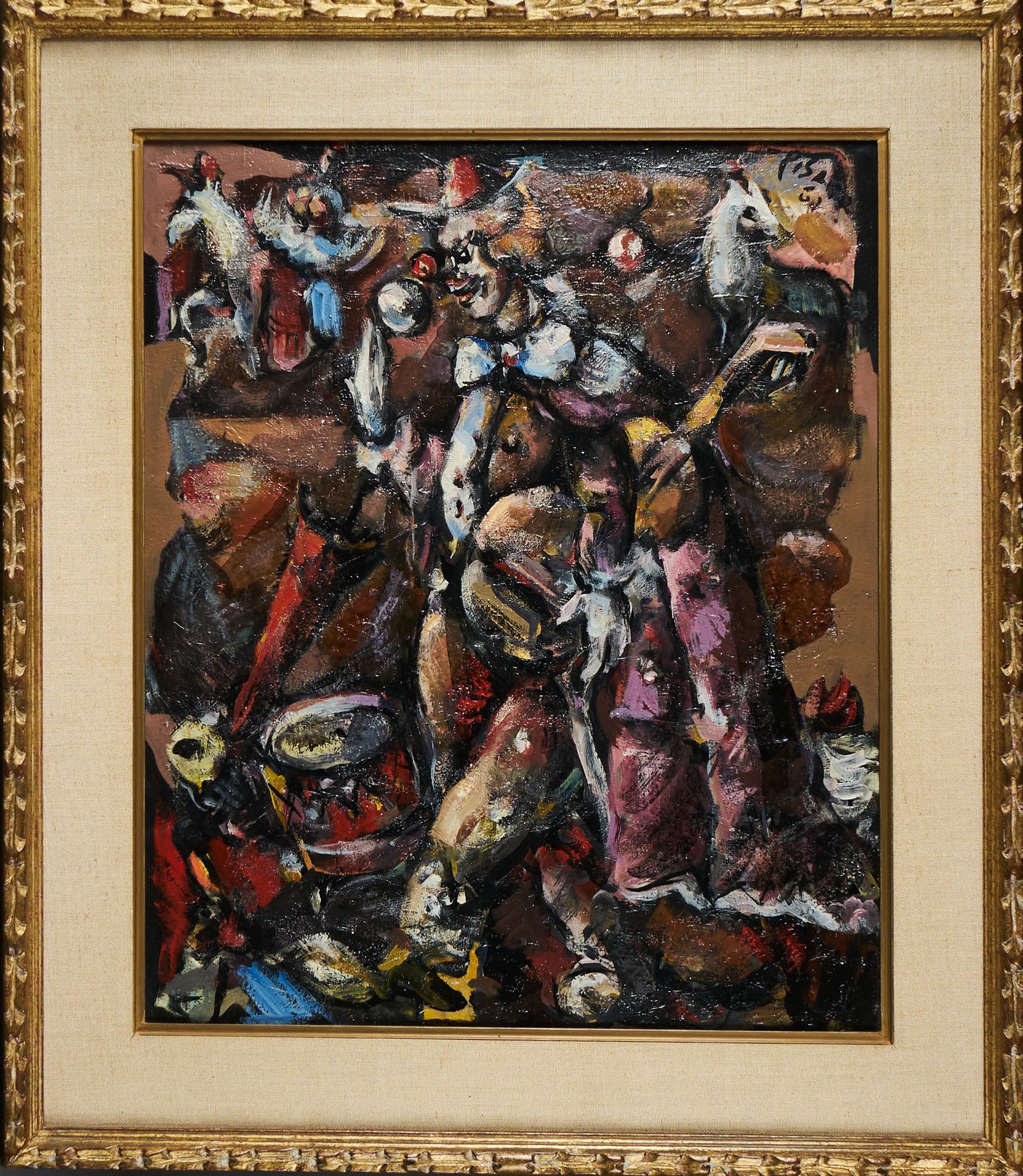
Eduardo PISANO (1912-1986). "Payaso", the clown. Oil on canvas signed and dated upper right, titled on the back (slightly missing). Height : 65 cm 65 cm - Width : 54 cm Note: Born in Spain, he attended evening classes at the Escuela de Artes y Oficios founded by Hermilio Alcalde del Rio, and moved to Madrid in 1930, frequenting museums and exhibitions, but remaining relatively indifferent to avant-garde currents such as Vibrationism, Cubism, Surrealism and Expressionism. Pisano attended evening classes at the Escuela de Artes Graficas, where he studied engraving techniques in depth. His love of color led him to devote himself primarily to painting, and he was fascinated by the works of El Greco and Velasquez. In 1939, he fled Franco's revolution and emigrated to France, Despite these long years, marked by the camps and the war, Eduardo Pisano never abandoned his Spanish roots, and the evocation of his native Cantabria remains for him the driving force behind his pictorial creation. The figures of acrobats, street clowns, dancers and bullfighters, as well as rugged landscapes, the sea, peasants working in the fields, floral compositions, still lifes and women are major subjects for Pisano, making him an active member of the Ecole de Paris.
Estimate
€200 - €300
Result
€220
Buyer's premium
28.8%
Eduardo PISANO (1912-1986).
"Payaso", the clown.
Oil on canvas signed and dated upper right, titled on the back (slightly missing).
Height : 65 cm 65 cm - Width : 54 cm
Note: Born in Spain, he attended evening classes at the Escuela de Artes y Oficios founded by Hermilio Alcalde del Rio, and moved to Madrid in 1930, frequenting museums and exhibitions, but remaining relatively indifferent to avant-garde currents such as Vibrationism, Cubism, Surrealism and Expressionism. Pisano attended evening classes at the Escuela de Artes Graficas, where he studied engraving techniques in depth. His love of color led him to devote himself primarily to painting, and he was fascinated by the works of El Greco and Velasquez.
In 1939, he fled Franco's revolution and emigrated to France,
Despite these long years, marked by the camps and the war, Eduardo Pisano never abandoned his Spanish roots, and the evocation of his native Cantabria remains for him the driving force behind his pictorial creation.
The figures of acrobats, street clowns, dancers and bullfighters, as well as rugged landscapes, the sea, peasants working in the fields, floral compositions, still lifes and women are major subjects for Pisano, making him an active member of the Ecole de Paris.
Sale
Thursday 21 May・09:30 (Europe/Paris)
Sale location coming soon
1 ter, boulevard de la République
92210 Saint-Cloud