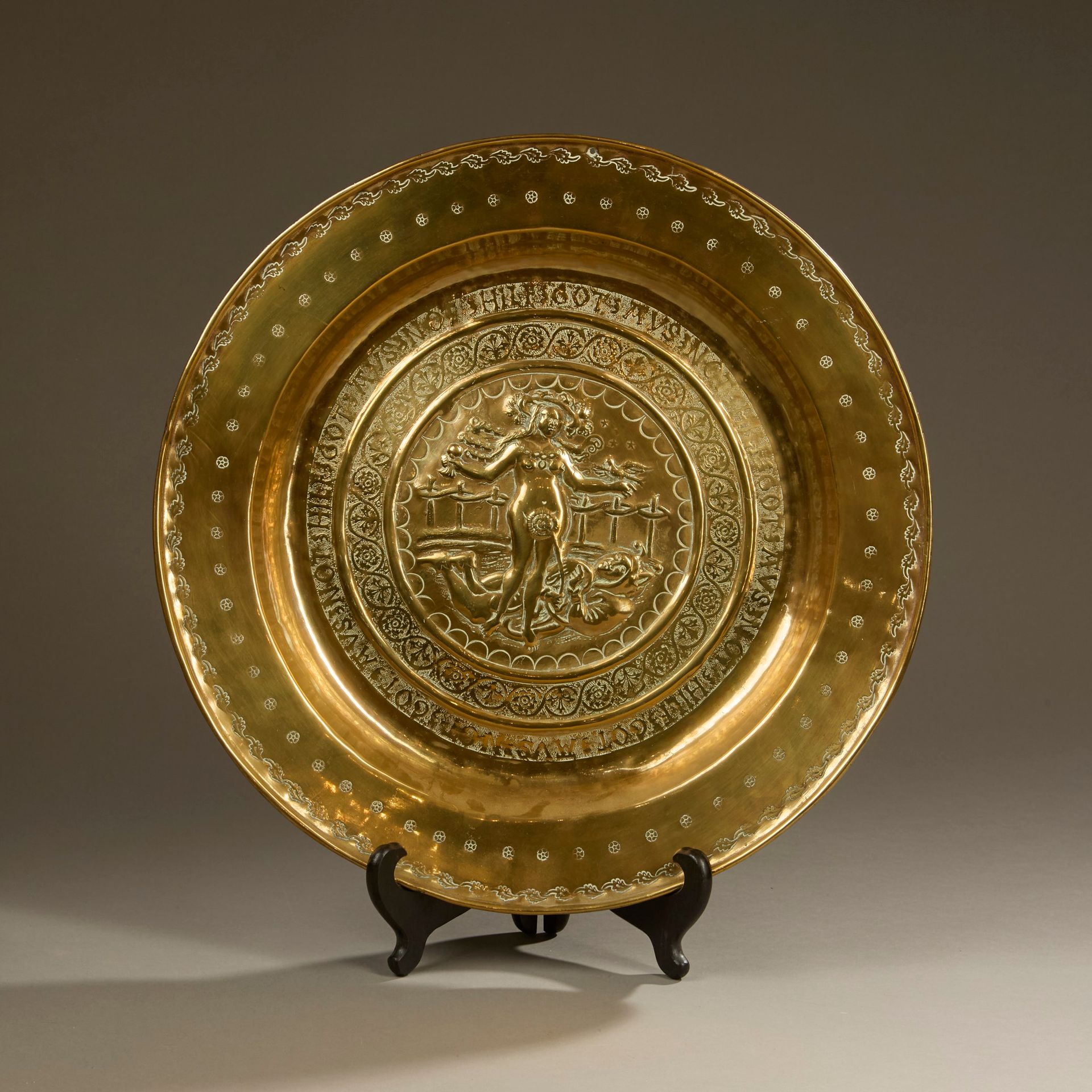
Stamped, hallmarked and engraved brass offering dish depicting the Courtesan and the Fool. The rim is slightly raised, the wing punched with a frieze of palmettes and a row of fleurons, the base smooth. The basin is adorned with two concentric bands separated by a raised border, the first bearing the inscription "HILF GOT AUS NOT" (God help us in our hour of need), the second a frieze of interlaced circular foliage alternating with fleurons and trifoliate motifs. The background, bordered by a frieze of festoons, depicts an orchard landscape against a starry sky, against which the figure of a nude woman whose finery consists of a hat adorned with a garland of feathers. A cuckoo clock is perched on her left hand, and with her right hand she is waving an infant's teat enclosing a bell. At her feet lies a jester, dressed in a hooded tunic: he holds the long stem of a rose whose petals brush against and conceal the woman's sex (slight accidents). Southern Germany, Nuremberg, first half of the 16th century. Diameter: 42.2 cm Bibliography - E. Antoine-König and P.-Y. Le Pogam (dir.), Figures du fou. Du Moyen Âge aux Romantiques [catalog of the exhibition presented at the Musée du Louvre, October 16, 2024 - February 3, 2025], Paris, Musée du Louvre, Gallimard, 2024, no. 67, pp. 88-89 and 356-357. - K. Tiedemann, Nürnberger Beckenschlägerschüsseln, Dettelbach, J. H. Röll, 2018, pp. 130- 131. Note: The saucy scene on this offering plate comes from a series of woodcuts distributed in southern Germany from the second quarter of the 16th century onwards; it is probably the work of a Nuremberg artist, perhaps to be identified with Hans Sebald Beham (1500-1550) (fig.). All the evidence suggests that this decoration is a subtle warning against the alienation caused by the abuse of the pleasures of the flesh. As W. Metzger, the rose, symbol of love par excellence, suggests the metaphorical use of the word "flower" to designate female virginity, evoking the term "deflower" that follows. Allegory of Venus or Voluptuousness, the woman is holding a cuckoo clock, whose German name "Kuckuck" gave rise, by analogy, to the term "Gauch", which designates a man infatuated with a courtesan to the point of madness. Such is the raison d'être of the pacifier and the bell: allusions to the lover whose passion has made him fall back into childhood. The success of this image is attested by its widespread use on goldsmith's and copperware pieces. Related works : - A comparable example, dated circa 1535, is on display at Berlin's Kunstgewerbemuseum (inv. 1928, 39). The erotically charged iconography of these objects led W. Metzger to question their traditional designation as "alms dishes". The inscription, however, calls for God's help in times of trial, which it is tempting to equate with the lures of the flesh. It is not impossible that such an image was intended to remind the faithful that true love, as Montherlant wrote, "is not the love of faces". - At the Musée du Louvre's exhibition of Figures of the Fool from the Middle Ages to the Romantics, a brass basin was presented with the same decoration ((Berlin, Staatliche Museen zu Berlin, Kunstgewerbemuseum, inv. 1928,39) Appraisal by Mr Benoît BERTRAND - 06 88 47 62 42 - bbertrand0870@gmail.com
Estimate
€400 - €600
Result
€6,200
Buyer's premium
28.8%
Stamped, hallmarked and engraved brass offering dish depicting the Courtesan and the Fool. The rim is slightly raised, the wing punched with a frieze of palmettes and a row of fleurons, the base smooth. The basin is adorned with two concentric bands separated by a raised border, the first bearing the inscription "HILF GOT AUS NOT" (God help us in our hour of need), the second a frieze of interlaced circular foliage alternating with fleurons and trifoliate motifs. The background, bordered by a frieze of festoons, depicts an orchard landscape against a starry sky, against which the figure of a nude woman whose finery consists of a hat adorned with a garland of feathers. A cuckoo clock is perched on her left hand, and with her right hand she is waving an infant's teat enclosing a bell. At her feet lies a jester, dressed in a hooded tunic: he holds the long stem of a rose whose petals brush against and conceal the woman's sex (slight accidents).
Southern Germany, Nuremberg, first half of the 16th century.
Diameter: 42.2 cm
Bibliography
- E. Antoine-König and P.-Y. Le Pogam (dir.), Figures du fou. Du Moyen Âge aux Romantiques [catalog of the exhibition presented at the Musée du Louvre, October 16, 2024 - February 3, 2025], Paris, Musée du Louvre, Gallimard, 2024, no. 67, pp. 88-89 and 356-357.
- K. Tiedemann, Nürnberger Beckenschlägerschüsseln, Dettelbach, J. H. Röll, 2018, pp. 130- 131.
Note: The saucy scene on this offering plate comes from a series of woodcuts distributed in southern Germany from the second quarter of the 16th century onwards; it is probably the work of a Nuremberg artist, perhaps to be identified with Hans Sebald Beham (1500-1550) (fig.). All the evidence suggests that this decoration is a subtle warning against the alienation caused by the abuse of the pleasures of the flesh. As W. Metzger, the rose, symbol of love par excellence, suggests the metaphorical use of the word "flower" to designate female virginity, evoking the term "deflower" that follows. Allegory of Venus or Voluptuousness, the woman is holding a cuckoo clock, whose German name "Kuckuck" gave rise, by analogy, to the term "Gauch", which designates a man infatuated with a courtesan to the point of madness. Such is the raison d'être of the pacifier and the bell: allusions to the lover whose passion has made him fall back into childhood.
The success of this image is attested by its widespread use on goldsmith's and copperware pieces.
Related works :
- A comparable example, dated circa 1535, is on display at Berlin's Kunstgewerbemuseum (inv. 1928, 39). The erotically charged iconography of these objects led W. Metzger to question their traditional designation as "alms dishes". The inscription, however, calls for God's help in times of trial, which it is tempting to equate with the lures of the flesh. It is not impossible that such an image was intended to remind the faithful that true love, as Montherlant wrote, "is not the love of faces".
- At the Musée du Louvre's exhibition of Figures of the Fool from the Middle Ages to the Romantics, a brass basin was presented with the same decoration ((Berlin, Staatliche Museen zu Berlin, Kunstgewerbemuseum, inv. 1928,39)
Appraisal by Mr Benoît BERTRAND - 06 88 47 62 42 - bbertrand0870@gmail.com
Sale
Sunday 31 May・14:00 (Europe/Paris)
Sale location coming soon
1 ter, boulevard de la République
92210 Saint-Cloud