[ILLUMINATED MANUSCRIPT]. [MAÎTRE DE FRANÇOIS DE ROHAN (atelier de) and Étienne COLAUD (workshop of/group)]. GAIGNY (Jean de). The Seven Words of Jesus Christ. Circa 1530. Illuminated manuscript on vellum skin, 357 leaves (dim. of a leaf : Height : 17 cm - Width : 12 cm), illustrated with 9 full-page illuminations, blue illuminated lettrines, mostly scrolled, accompanied by polychrome flowers or strawberries polychrome flowers or strawberries on a rippled gold background, chapter ends adorned with phylacteries in gold lettering on blue or red ribbon on a background of flowers, rubrication in red, "Amen", "Jesus Christi" and "Finis laus Deo" in gold lettering, the first page with small lettering on a gold background and framed by flowers and strawberries on a rippled gold background. Bound in full crimson velvet with laces, 5-ribbed spine, all edges gilt. Exceptional presentation manuscript addressed to Queen Marguerite de Valois- Angoulême as presented on the first page: "Le livre faisant mention des sept parolles que noste benoist saulveur amp; rédempteur Iesuchrist dict en l'arbre de la croix : avecques aucunes expositions amp; contemplations sur icelles extraictes des dicts amp; sentences des Docteurs auctenticques approuvez de Saincte église. Faict amp; composée pour très haulte, Illustre amp; dévote Dame Madame Margarite de France ; Royne de Navarre, Duchesse d'Alençon, de Berry amp; Comtesse D'armygnac, unique soeur germaine du roy. A elle presente amp; baille par ung Chanoine de la Saincte Chappelle, her most humble and perpetual servant. L'an Mil Cinq Cens Vingt cinq." The illustration consists of nine large miniatures. The first, full-page in a gilded frame, depicts Christ in the Garden of Olives, the phylactery inscribed "pater si possibile est transeat a me calix iste" (Matthew, 26). The second depicts the book's author handing over the work to Queen Marguerite d'Angoulême, kneeling before a covered table under a red canopy, the interior blue with fleur-de-lis semis, her coat of arms painted, framing border of flowers and strawberries on a riddled gold background. The following seven miniatures depict the seven words of Jesus Christ, respectively Jesus and the soldiers: "Pater, dimitte illis: non enim sciunt quid faciunt / Allios salvo / Vah! Qui destruis"; the good and the bad thief "Memento mei dum veneris in regnum tumm"; Mary and Saint John the Baptist "Mulier ecce filius tuus / Ecce mater tua"; the angels "Heloy, Heloy, lama sabachtani" ; Water and blood collection "Sitio"; God the Father on his right "Consummatum est"; Mary, St. John the Baptist and the centurion "In manus tuas commendo spiritum meum / Vere Filius Dei erat". The words are transcribed on one or more phylacteries. Each miniature is surrounded by a rich border, depicting the instruments of the Passion, or "Arma Christi", which make these illustrations so distinctive. These include the crown of thorns, the nails, the dice, the column surmounted by a rooster, the rods, the whip, the portraits of Judas and Pilate, the Holy Face, the purse, the lantern, the sword, the ciboriums and perfume jars, the hands, the cross, the hammers, the pliers, the coins, the sponges on the end of a pole and the open tomb. Stylistically, these illuminations are similar to the works of the so-called "Colaud Group" of artists, active around and in the style of the master. It seems that several hands were involved in the illustration of this work, and certain features, particularly in the first miniatures, also point to the entourage of the master of François de Rohan, who was canon of the Sainte Chapelle and author of Fleur de Vertu, the most famous manuscript to have belonged to the Queen. The text is by Jean de Gaigny (or Gagny), a Navarrese theologian who served as François I's first chaplain, and is considered one of the most influential men in the publishing and bibliophilic history of his time. He exhumed and printed numerous ancient texts, and was responsible for a large number of publications on patristic theology under the Soleil d'Or imprint. He is also renowned among bibliophiles for his collection of antique books and manuscripts, his taste for fine bindings and printing, as revealed by his patronage of Claude Garamont. Hundreds of texts were thus rediscovered by Jean de Gaigny and published. The text of the Seven Words went through numerous editions from the late 1520s and throughout the 1530s. First identified as 1535, the earliest printed edition appears to have been published in 1528 by Jean de Gaigny with Chrétien Weschel. Expert : M
Estimate
€20,000 - €30,000
Result
€60,000
Buyer's premium
28.8%
[ILLUMINATED MANUSCRIPT]. [MAÎTRE DE FRANÇOIS DE ROHAN (atelier de) and Étienne
COLAUD (workshop of/group)]. GAIGNY (Jean de). The Seven Words of Jesus Christ. Circa 1530.
Illuminated manuscript on vellum skin, 357 leaves (dim. of a leaf : Height : 17 cm - Width : 12 cm), illustrated with 9 full-page illuminations, blue illuminated lettrines, mostly scrolled, accompanied by polychrome flowers or strawberries
polychrome flowers or strawberries on a rippled gold background, chapter ends adorned with phylacteries in gold lettering on blue or red ribbon on a background of flowers, rubrication in red, "Amen", "Jesus Christi" and "Finis laus Deo" in gold lettering, the first page with small lettering on a gold background and framed by flowers and strawberries on a rippled gold background.
Bound in full crimson velvet with laces, 5-ribbed spine, all edges gilt.
Exceptional presentation manuscript addressed to Queen Marguerite de Valois- Angoulême as presented on the first page: "Le livre faisant mention des sept parolles que noste benoist saulveur amp; rédempteur
Iesuchrist dict en l'arbre de la croix : avecques aucunes expositions amp; contemplations sur icelles extraictes des dicts amp; sentences des Docteurs auctenticques approuvez de Saincte église. Faict amp; composée pour très haulte, Illustre amp; dévote Dame Madame Margarite de France ; Royne de Navarre, Duchesse d'Alençon, de Berry amp; Comtesse D'armygnac, unique soeur germaine du roy. A elle presente amp; baille par ung Chanoine de la Saincte Chappelle,
her most humble and perpetual servant. L'an Mil Cinq Cens Vingt cinq."
The illustration consists of nine large miniatures. The first, full-page in a gilded frame, depicts Christ in the Garden of Olives, the phylactery inscribed "pater si possibile est transeat a me calix iste" (Matthew, 26).
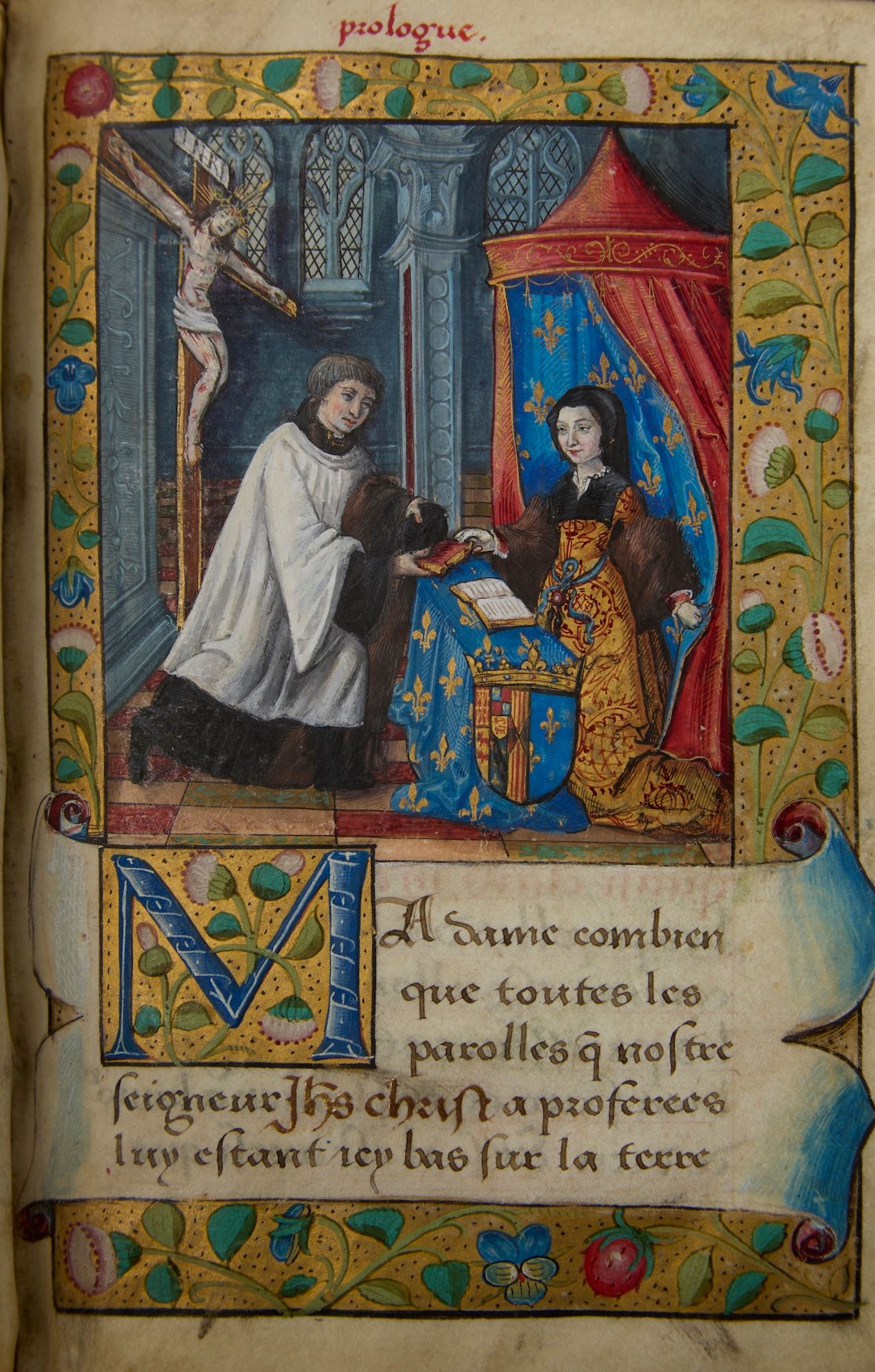
The second depicts the book's author handing over the work to Queen Marguerite d'Angoulême, kneeling before a covered table under a red canopy, the interior blue with fleur-de-lis semis, her coat of arms painted, framing border of flowers and strawberries on a riddled gold background. The following seven miniatures depict the seven words of Jesus Christ, respectively Jesus and the soldiers: "Pater, dimitte illis: non enim sciunt quid faciunt / Allios
salvo / Vah! Qui destruis"; the good and the bad thief "Memento mei dum veneris in regnum tumm"; Mary and Saint John the Baptist "Mulier ecce filius tuus / Ecce mater tua"; the angels "Heloy, Heloy, lama sabachtani" ; Water and blood collection "Sitio"; God the Father on his right "Consummatum est"; Mary, St. John the Baptist and the centurion "In manus tuas commendo spiritum meum / Vere Filius Dei erat". The words are transcribed on one or more phylacteries. Each miniature is surrounded by a rich border, depicting the instruments of the Passion, or "Arma Christi", which make these illustrations so distinctive. These include the crown of thorns, the nails, the dice, the column surmounted by a rooster, the rods, the whip, the portraits of Judas and Pilate, the Holy Face, the purse, the lantern, the sword, the ciboriums and perfume jars, the hands, the cross, the hammers, the pliers, the coins, the sponges on the end of a pole and the open tomb.
Stylistically, these illuminations are similar to the works of the so-called "Colaud Group" of artists, active around and in the style of the master. It seems that several hands were involved in the illustration of this work, and certain features, particularly in the first miniatures, also point to the entourage of the master of François de Rohan, who was canon of the Sainte Chapelle and author of Fleur de Vertu, the most famous manuscript to have belonged to the Queen.
The text is by Jean de Gaigny (or Gagny), a Navarrese theologian who served as François I's first chaplain, and is considered one of the most influential men in the publishing and bibliophilic history of his time. He exhumed and printed numerous ancient texts, and was responsible for a large number of publications on patristic theology under the Soleil d'Or imprint. He is also renowned among bibliophiles for his collection of antique books and manuscripts, his taste for fine bindings and printing, as revealed by his patronage of Claude Garamont. Hundreds of texts were thus rediscovered by Jean de Gaigny and published. The text of the Seven Words went through numerous editions from the late 1520s and throughout the 1530s. First identified as 1535, the earliest printed edition appears to have been published in 1528 by Jean de Gaigny with Chrétien Weschel.
Expert : M
Sale
Thursday 23 April・09:30 (Europe/Paris)
Sale location coming soon
1 ter, boulevard de la République
92210 Saint-Cloud