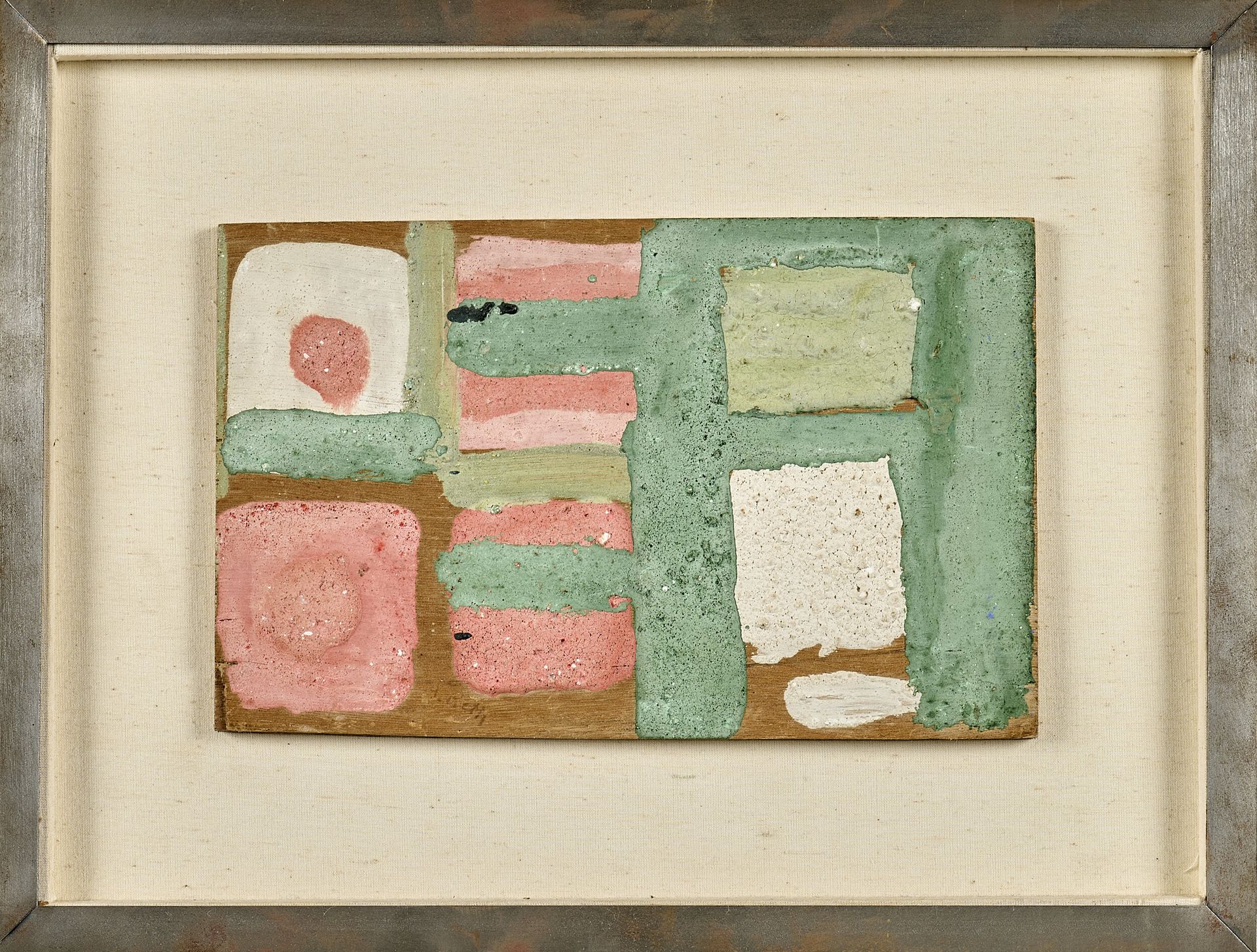
Alfred RETH (1884-1966). "Harmonie de matières", pink and green, circa 1943. Oil and relief on wood, signed lower left. Height 16 cm - Width 25 cm Bibliography: Cserba Julia, Maklary Kalman, Alfred Reth. 1884-1966 Du cubisme à l'abstraction. Editions Maklary artsworks, 2003, p. 243 reproduced under number 183. Note: a naturalized French Hungarian painter, he is considered one of the great faces of the Avant-Garde and the Ecole de Paris. He was introduced to Cubism by Jacques-Emile Blanche and Maurice Esmein in Montmartre. Later, while visiting the Musée Guimet, he developed an interest in Hindu and Khmer art. The influence of Cézanne, whom he studied from 1907 onwards, was felt. He joined Cubism in 1911 and exhibited several paintings at the Salon des Indépendants, alongside Matisse and Rouault, and later Braque, Léger, Lhote, Metzinger and de Segonzac, who became his friends. After the First World War, he joined the Abstraction - création : Art non figuratif movement alongside Arp, Georges Valmier, Herbin and Kupka, and steered his artistic production towards abstract forms and non-figurative art, without totally abandoning the figurative and collage art he loved so much. His work can be seen at the Centre Pompidou.
Estimate
€800 - €1,000
Result
Not communicated
Buyer's premium
28.8%
Alfred RETH (1884-1966).
"Harmonie de matières", pink and green, circa 1943.
Oil and relief on wood, signed lower left.
Height 16 cm - Width 25 cm
Bibliography: Cserba Julia, Maklary Kalman, Alfred Reth. 1884-1966 Du cubisme à l'abstraction. Editions Maklary artsworks, 2003, p. 243 reproduced under number 183.
Note: a naturalized French Hungarian painter, he is considered one of the great faces of the Avant-Garde and the Ecole de Paris. He was introduced to Cubism by Jacques-Emile Blanche and Maurice Esmein in Montmartre. Later, while visiting the Musée Guimet, he developed an interest in Hindu and Khmer art. The influence of Cézanne, whom he studied from 1907 onwards, was felt. He joined Cubism in 1911 and exhibited several paintings at the Salon des Indépendants, alongside Matisse and Rouault, and later Braque, Léger, Lhote, Metzinger and de Segonzac, who became his friends.
After the First World War, he joined the Abstraction - création : Art non figuratif movement alongside Arp, Georges Valmier, Herbin and Kupka, and steered his artistic production towards abstract forms and non-figurative art, without totally abandoning the figurative and collage art he loved so much. His work can be seen at the Centre Pompidou.
Sale
Sunday 30 November 2025・14:00 (Europe/Paris)
Sale location coming soon
1 ter, boulevard de la République
92210 Saint-Cloud