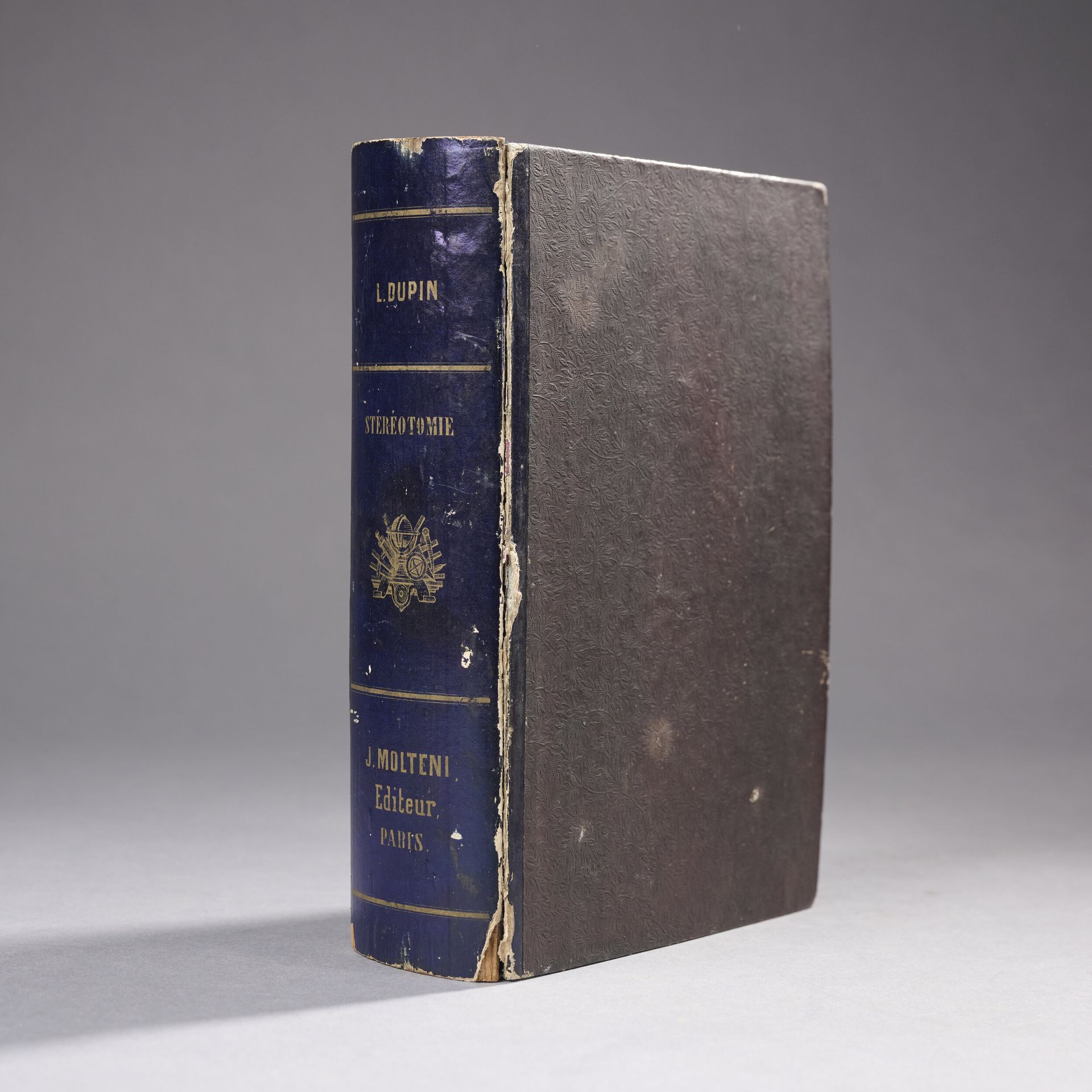
DUPIN (Louis). Stereometric geometry - decomposition of the cube, into regular, irregular polyhedra and round bodies, forming between them a right-angled parallelepiped. Appliqué à l'étude de la géométrie de la coupe des pierres, de la charpente et de la minéralogie. Paris, Molteni, circa 1842-1850. Set of 34 geometric shapes in cardboard printed in black ink with imitation wood motifs, their names and various information and measurements, and numbered (1 to 42). In a cardboard box simulating a book, author, title and publisher gilded on the spine, nomenclature label glued under the lid. Very rare example of a "mathematical puzzle" created by Louis Dupin around 1842. The aim of these models was to enable elementary school and arts and crafts students to learn three-dimensional and descriptive geometry through the development of spatial vision and the practical manipulation of volumes. Applications included the study of stereotomy, perspective, architecture and mineralogy. Initially made of wood, they were later replaced by printed, cut and folded cardboard sheets, which were less expensive and more resistant to falling than wood. According to science historian Michael Friedman (A History of Folding in Mathematics: Mathematizing the Margins (Science Networks. Historical Studies, 59), Berlin, Birkhäuser, 2018.), the use of geometric volumes in learning complex geometry has been documented since the Renaissance, but Louis Dupin's models are distinguished by the fact that formulas and properties are inscribed directly on the polyhedra. The volumes constitute the teaching element in their own right, without needing to be accompanied by a textbook or reference book. Several editions produced by Molteni and Hachette appeared during the 1840s, with slight variations in the number of shapes and the container. Our copy contains 34 shapes numbered from 1 to 42, although the nomenclature stops at number 41. Similar examples can be found in the collections of the Musée des Arts et Métiers and Harvard University. Provenance: Claudius Cunit (1814 - 1866) - Polytechnicien (X 1833) - Ingénieur en chef des Ponts et Chaussées - Chevalier de la Légion d'Honneur - Membre de l'Académie Delphinale. (Copy probably incomplete with eight pieces, some wear, small knocks and small chips to the box, rubbing slightly affecting the text in some figures, some dull corners, hole inside figure 36). Expert : Mr. Nicolas Asvisio
Estimate
€1,000 - €2,000
Result
€1,200
Buyer's premium
27%
DUPIN (Louis). Stereometric geometry - decomposition of the cube, into regular, irregular polyhedra and round bodies, forming between them a right-angled parallelepiped.
Appliqué à l'étude de la géométrie de la coupe des pierres, de la charpente et de la minéralogie. Paris, Molteni, circa 1842-1850.
Set of 34 geometric shapes in cardboard printed in black ink with imitation wood motifs, their names and various information and measurements, and numbered (1 to 42).
In a cardboard box simulating a book, author, title and publisher gilded on the spine, nomenclature label glued under the lid.
Very rare example of a "mathematical puzzle" created by Louis Dupin around 1842. The aim of these models was to enable elementary school and arts and crafts students to learn three-dimensional and descriptive geometry through the development of spatial vision and the practical manipulation of volumes. Applications included the study of stereotomy, perspective, architecture and mineralogy. Initially made of wood, they were later replaced by printed, cut and folded cardboard sheets, which were less expensive and more resistant to falling than wood.
According to science historian Michael Friedman (A History of Folding in Mathematics: Mathematizing the Margins (Science Networks. Historical Studies, 59), Berlin, Birkhäuser, 2018.), the use of geometric volumes in learning complex geometry has been documented since the Renaissance, but Louis Dupin's models are distinguished by the fact that formulas and properties are inscribed directly on the polyhedra. The volumes constitute the teaching element in their own right, without needing to be accompanied by a textbook or reference book.
Several editions produced by Molteni and Hachette appeared during the 1840s, with slight variations in the number of shapes and the container. Our copy contains 34 shapes numbered from 1 to 42, although the nomenclature stops at number 41.
Similar examples can be found in the collections of the Musée des Arts et Métiers and Harvard University.
Provenance: Claudius Cunit (1814 - 1866) - Polytechnicien (X 1833) - Ingénieur en chef des Ponts et Chaussées - Chevalier de la Légion d'Honneur - Membre de l'Académie Delphinale.
(Copy probably incomplete with eight pieces, some wear, small knocks and small chips to the box, rubbing slightly affecting the text in some figures, some dull corners, hole inside figure 36).
Expert : Mr. Nicolas Asvisio
Sale
Thursday 17 April 2025・14:00 (Europe/Paris)
Sale location coming soon
1 ter, boulevard de la République
92210 Saint-Cloud