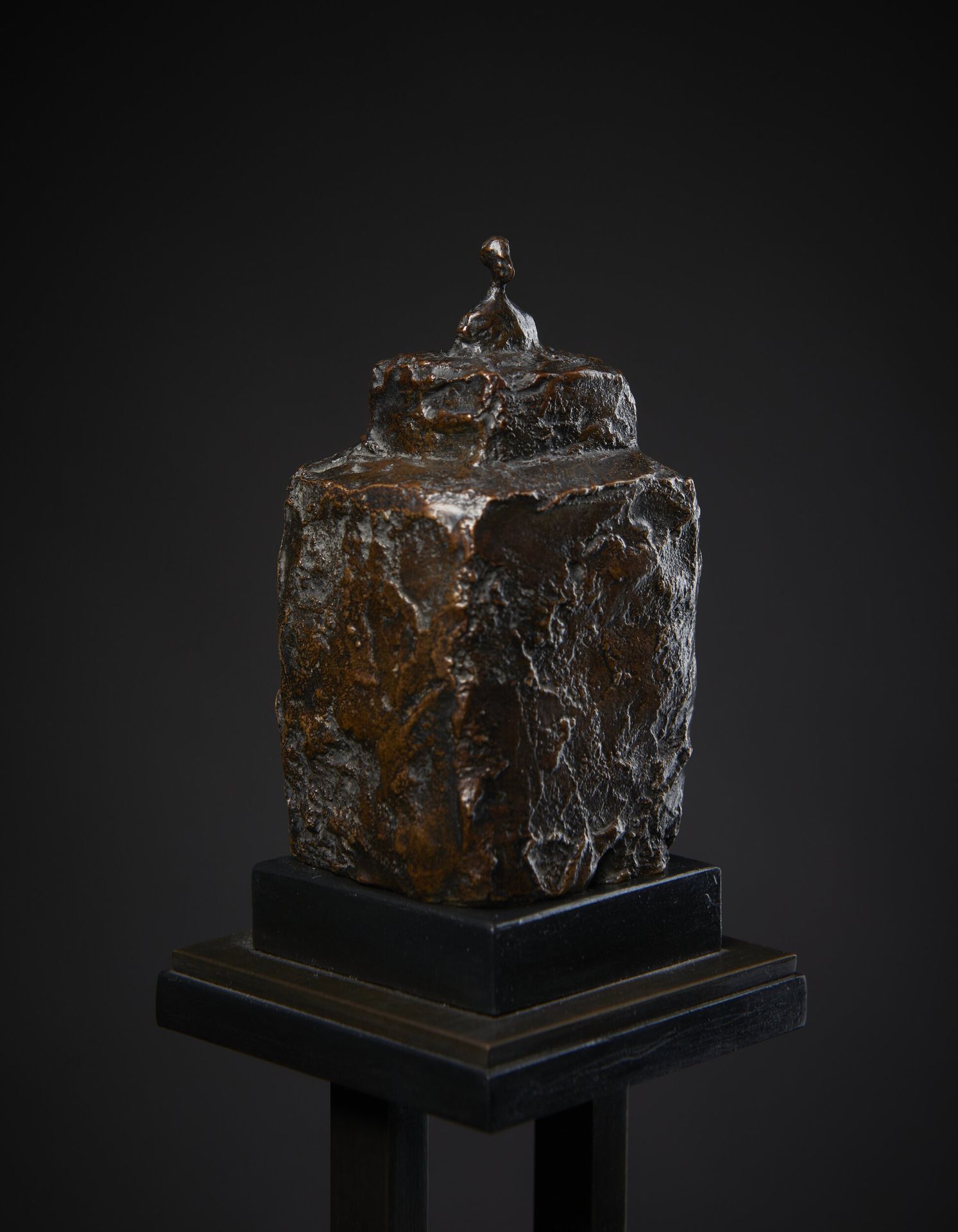
Alberto GIACOMETTI (1901- 1966). "Small bust on double pedestal". Bronze signed and numbered 1 / 8 on the left side of the base. Foundry stamp L. Thinot Paris, on back. Height 11.3 cm - Width: 6.2 cm - Depth: 5.4 cm Designed in 1940-41, cast in 1971. Height of metal presentation base: 126 cm A certificate from the Giacometti Committee will be given to the purchaser (work examined by the Committee on March 8, 2006). Other examples: - No. 3 / 8 is in the collection of the Alberto Giacometti Stiftung, Zürich (GS184). - No. 6 / 8 was auctioned by the Annette Giacometti estate on September 28, 2002. Provenance : - Sale May 4, 2006 Sotheby's New York, N° 413 ; - Galerie Patrice Trigano, Paris; - Private collection, Paris. Note: Alberto Giacometti (1901-1966) was a Swiss sculptor, painter and draughtsman known for his wiry figures that convey a profound vision of the human condition. Born into a family of artists, Giacometti studied at the Beaux-Arts in Geneva before moving to Paris in 1922. He frequented Surrealist circles, influenced by André Breton, but gradually distanced himself from the movement to engage in more personal research. Since 1938, Alberto Giacometti has tried to capture the sudden awareness of a distant knowledge. After the Second World War, he became a central figure in existentialism, notably through his friendship with Jean-Paul Sartre (Alberto Giacometti Stiftung, Zürich). Created during a pivotal period in his career, our work is a bronze sculpture that reflects Giacometti's stylistic evolution, far from the slender, wiry figures that would mark his post-war work. Until 1946, he pursued the impossible project of inscribing vision at a distance in a sculpture, exploring the representation of the human body through increasingly reduced, almost miniature forms. On the one hand, he made the small figures smaller and smaller; on the other, disproportionate pedestals were intended to suggest distance, like the frame of a painting. This extreme reduction of proportions is a response to Giacometti's questioning Giacometti's questions about distance and vision: he sought to sculpt not the object itself, but the image that our gaze retains of it. Appraisal by Mr. Irénée BRUN - 01 42 60 45 45 - brun.perazzone@gmail.com
Estimate
€150,000 - €200,000
Result
Not communicated
Buyer's premium
27%
Alberto GIACOMETTI (1901- 1966).
"Small bust on double pedestal".
Bronze signed and numbered 1 / 8 on the left side of the base. Foundry stamp L. Thinot Paris, on back.
Height 11.3 cm - Width: 6.2 cm - Depth: 5.4 cm
Designed in 1940-41, cast in 1971.
Height of metal presentation base: 126 cm
A certificate from the Giacometti Committee will be given to the purchaser (work examined by the Committee on March 8, 2006).
Other examples:
- No. 3 / 8 is in the collection of the Alberto Giacometti Stiftung, Zürich (GS184).
- No. 6 / 8 was auctioned by the Annette Giacometti estate on September 28, 2002.
Provenance :
- Sale May 4, 2006 Sotheby's New York, N° 413 ;
- Galerie Patrice Trigano, Paris;
- Private collection, Paris.
Note: Alberto Giacometti (1901-1966) was a Swiss sculptor, painter and draughtsman known for his wiry figures that convey a profound vision of the human condition. Born into a family of artists, Giacometti studied at the Beaux-Arts in Geneva before moving to Paris in 1922. He frequented Surrealist circles, influenced by André Breton, but gradually distanced himself from the movement to engage in more personal research.
Since 1938, Alberto Giacometti has tried to capture the sudden awareness of a distant knowledge. After the Second World War, he became a central figure in existentialism, notably through his friendship with Jean-Paul Sartre (Alberto Giacometti Stiftung, Zürich).
Created during a pivotal period in his career, our work is a bronze sculpture that reflects Giacometti's stylistic evolution, far from the slender, wiry figures that would mark his post-war work. Until 1946, he pursued the impossible project of inscribing vision at a distance in a sculpture, exploring the representation of the human body through increasingly reduced, almost miniature forms. On the one hand, he made the small figures smaller and smaller; on the other, disproportionate pedestals were intended to suggest distance, like the frame of a painting. This extreme reduction of proportions is a response to Giacometti's questioning
Giacometti's questions about distance and vision: he sought to sculpt not the object itself, but the image that our gaze retains of it.
Appraisal by Mr. Irénée BRUN - 01 42 60 45 45 - brun.perazzone@gmail.com
Sale
Sunday 30 March 2025・14:00 (Europe/Paris)
Sale location coming soon
1 ter, boulevard de la République
92210 Saint-Cloud