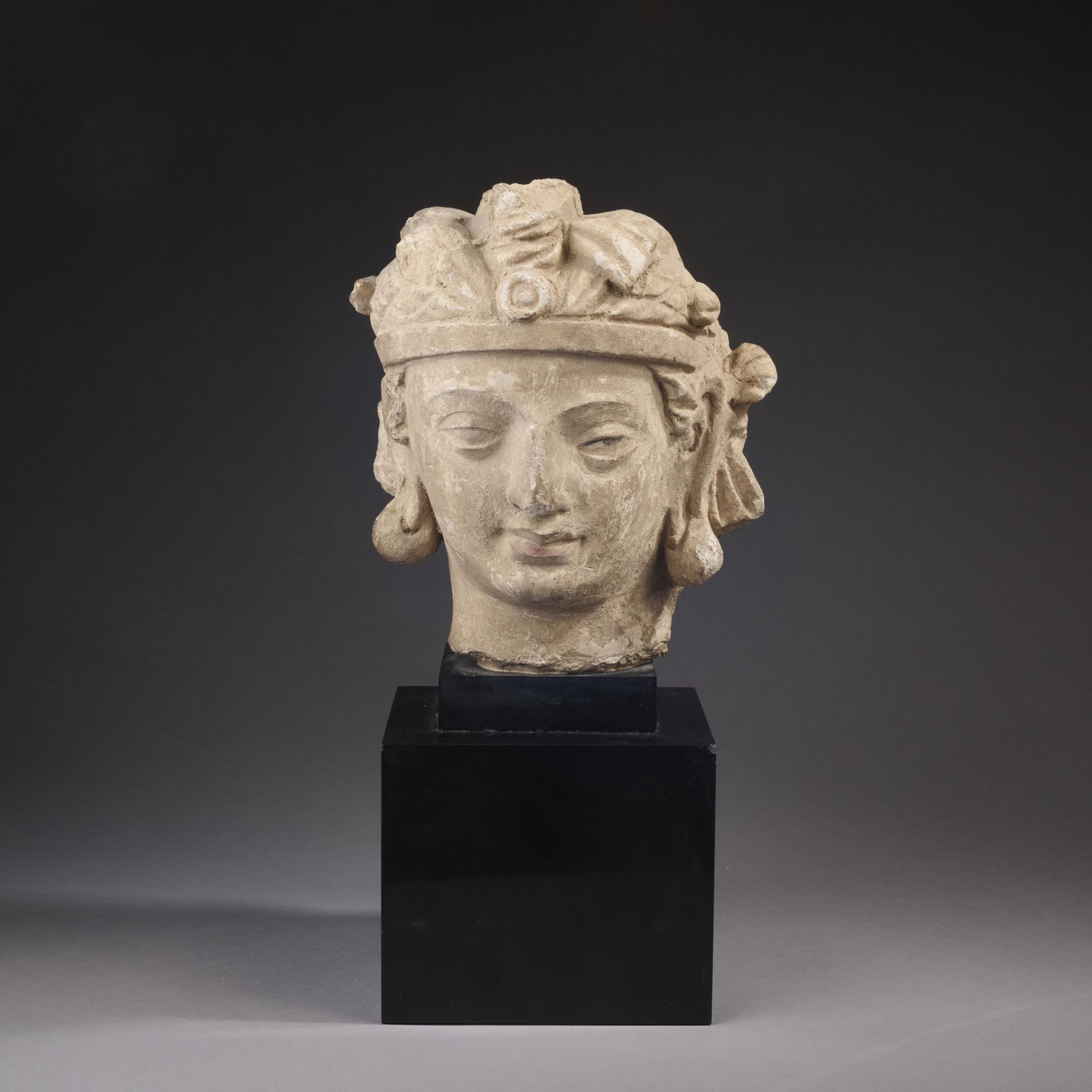
Gandhara head. Stucco with polychrome remains. Gandhara, 3rd - 6th centuries. Height 23 cm - Width 20 cm Cubic base in black marble. This stucco head features a complex headdress, with coiled locks of hair held in place by a headband delicately tied to the side. It is also adorned with large earrings. This head is reminiscent of the style on the Hadda archaeological site. For an example of a stucco head from Hadda, see the exhibition catalog Afghanistan, Ombres et Légendes, Musée National des Arts Asiatiques - Guimet, 2002, Liénart éditions, p.39, ill. 11. Note: Gandhara was the ancient region of northwestern India, northern Pakistan and northeastern Afghanistan conquered by Alexander the Great around 330 B.C., whose passage encouraged the spread of Hellenistic art by Western craftsmen, whose style had a major influence on the region's statuary. Visited by merchants, craftsmen and pilgrims, Gandhara was a veritable commercial and cultural crossroads between the West and the Far East. Around the first century AD, Buddhism moved westwards, leading to the foundation of numerous monastic centers where an art form illustrating the marvelous life of the Buddha was born, with stylistic influences from neighboring regions or further afield. The region's statuary, often referred to as "Greco-Buddhist", reflects this association, blending Indian Buddhist art with that of Central Asia and the West. Enclosed is the purchase invoice from Compagnie de la Chine et des Indes, 39 avenue de Friedland, Paris, dated November 25, 1941. Appraised by Mr. Alexis RENARD.
Estimate
€1,000 - €1,500
Result
€4,000
Buyer's premium
27%
Gandhara head.
Stucco with polychrome remains.
Gandhara, 3rd - 6th centuries.
Height 23 cm - Width 20 cm
Cubic base in black marble.
This stucco head features a complex headdress, with coiled locks of hair held in place by a headband delicately tied to the side. It is also adorned with large earrings. This head is reminiscent of the style on the Hadda archaeological site.
For an example of a stucco head from Hadda, see the exhibition catalog Afghanistan, Ombres et Légendes, Musée National des Arts Asiatiques - Guimet, 2002, Liénart éditions, p.39, ill. 11.
Note: Gandhara was the ancient region of northwestern India, northern Pakistan and northeastern Afghanistan conquered by Alexander the Great around 330 B.C., whose passage encouraged the spread of Hellenistic art by Western craftsmen, whose style had a major influence on the region's statuary. Visited by merchants, craftsmen and pilgrims, Gandhara was a veritable commercial and cultural crossroads between the West and the Far East. Around the first century AD, Buddhism moved westwards, leading to the foundation of numerous monastic centers where an art form illustrating the marvelous life of the Buddha was born, with stylistic influences from neighboring regions or further afield. The region's statuary, often referred to as "Greco-Buddhist", reflects this association, blending Indian Buddhist art with that of Central Asia and the West.
Enclosed is the purchase invoice from Compagnie de la Chine et des Indes, 39 avenue de Friedland, Paris, dated November 25, 1941.
Appraised by Mr. Alexis RENARD.
Sale
Sunday 9 February 2025・14:00 (Europe/Paris)
Sale location coming soon
1 ter, boulevard de la République
92210 Saint-Cloud