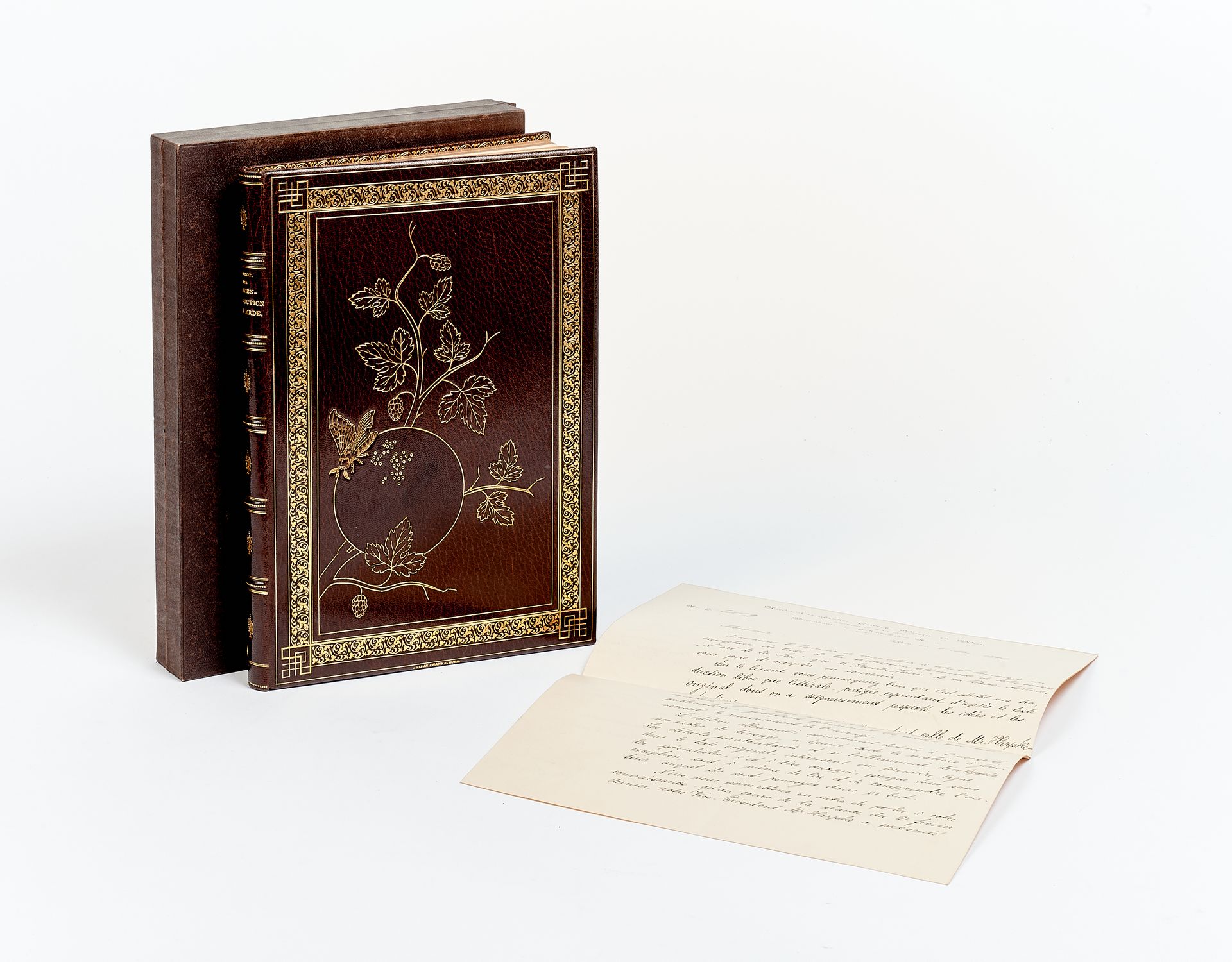
RONDOT (Natalis). Die seidenproduction der erde. Wien, 1890. In-8, first edition of the German translation of the Art of Silk, edited by Franz Bujatti. Bound in full brown morocco, the first plate richly decorated with a bombyx of the mulberry tree leaving its eggs on a branch of mulberry, in a framing of fillets and arabesque frieze, spine decorated with 5 nerves, all edges gilt, signed Julius Frank. In its slipcase. Accompanied by the present letter to the author. Provenance: Natalis Rondot French economist, art historian and silk industrialist, Natalis Rondot was delegated by the Reims Chamber of Commerce to represent France in China on an extraordinary mission to negotiate trade treaties from 1843 to 1846. During this trip, Natalis Rondot became interested in Chinese, Japanese and Indochinese cultures, their silk-working techniques and learned Chinese. On his return, he made a decisive contribution to the development of Lyon's silk industry in the 1850s. Appointed by the Chamber of Commerce in 1856, he founded the Musée d'Art et d'Industrie de Lyon, the future Musée Historique des Tissus, which he inaugurated in 1864.
Estimate
€200 - €400
Result
€1,000
Buyer's premium
27%
RONDOT (Natalis). Die seidenproduction der erde. Wien, 1890.
In-8, first edition of the German translation of the Art of Silk, edited by Franz Bujatti.
Bound in full brown morocco, the first plate richly decorated with a bombyx of the mulberry tree leaving its eggs on a branch of mulberry, in a framing of fillets and arabesque frieze, spine decorated with 5 nerves, all edges gilt, signed Julius Frank. In its slipcase.
Accompanied by the present letter to the author.
Provenance: Natalis Rondot
French economist, art historian and silk industrialist, Natalis Rondot was delegated by the Reims Chamber of Commerce to represent France in China on an extraordinary mission to negotiate trade treaties from 1843 to 1846. During this trip, Natalis Rondot became interested in Chinese, Japanese and Indochinese cultures, their silk-working techniques and learned Chinese. On his return, he made a decisive contribution to the development of Lyon's silk industry in the 1850s. Appointed by the Chamber of Commerce in 1856, he founded the Musée d'Art et d'Industrie de Lyon, the future Musée Historique des Tissus, which he inaugurated in 1864.
Sale
Thursday 31 October 2024・14:00 (Europe/Paris)
Sale location coming soon
1 ter, boulevard de la République
92210 Saint-Cloud