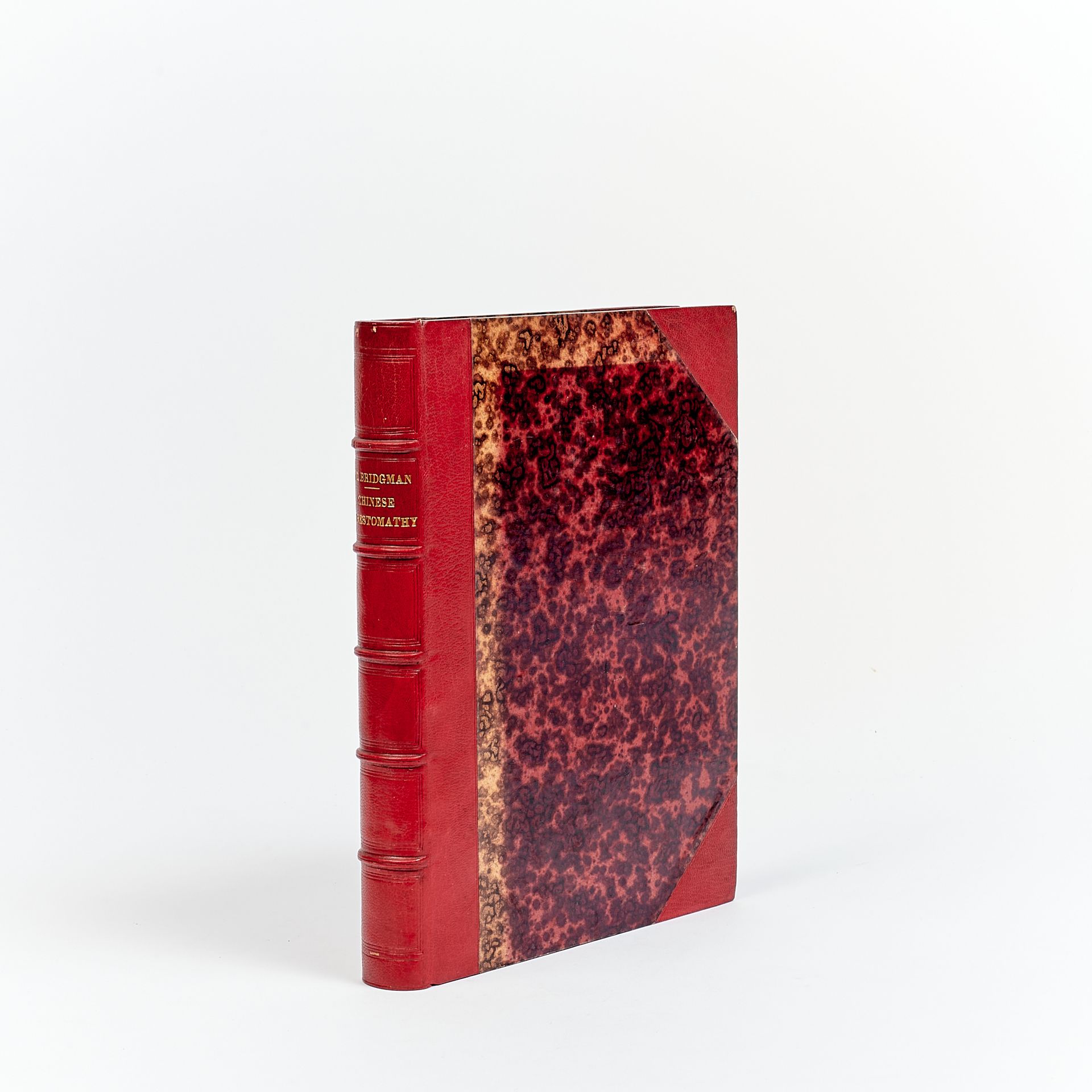
BRIDGMAN (Elijah Coleman). A Chinese chrestomathy in the Canton dialect. Macau, 1841. Large in-8, first edition of one of the major books summarizing the Western view of the Asian Orient. The book was published with three main aims in mind: to enable Westerners to learn Cantonese, to show how Cantonese can be expressed and learned through translation into Roman characters, and to disseminate a comprehensive overview of Chinese culture while improving relations between foreigners and Chinese. Through the themes and examples chosen, it provides a portrait of the Chinese people that has had a lasting impact on Western vision. The text is presented in 3 columns, accompanied by the author's notes. The central column presents the Chinese text written in ideograms, the right-hand column the phonetic translation in Roman characters, and the left-hand column the English translation. The book also includes an explanation of the tones and two fold-out plates of ideograms. Topics covered include the human body, human relations, social classes, domestic affairs, commercial and mechanical affairs, architecture, agriculture, liberal arts, mathematics, geography, mineralogy, botany, zoology, medicine and government affairs. Robert Thom, J. R. Morrison and S. Wells Williams contributed to the work. Enriched copy with an autograph letter signed by the author (1 ff. recto verso), bound at the head, located in Canton and dated December 26, 1845, addressed to Natalis Rondot concerning several translation requests. Bound in Lortic's signature red half-maroquin with corners, 5-ribbed spine, cold-stamped bindings, gilt title and author, marbled edges. Provenance: Natalis Rondot (tiny tear at top of spine, light stain on preface and contents pages) Provenance: Natalis Rondot French economist, art historian and silk industrialist, Natalis Rondot was delegated by the Reims Chamber of Commerce to represent France in China on an extraordinary mission to negotiate trade treaties from 1843 to 1846. During this trip, Natalis Rondot became interested in Chinese, Japanese and Indochinese cultures, their silk-working techniques and learned Chinese. On his return, he made a decisive contribution to the development of Lyon's silk industry in the 1850s. Appointed by the Chamber of Commerce in 1856, he founded the Musée d'Art et d'Industrie de Lyon, the future Musée Historique des Tissus, which he inaugurated in 1864. Expert: Mr Nicolas Asvisio - nicolas.asvisio@gmail.com - 06 47 79 88 52
Estimate
€400 - €600
Result
€2,300
Buyer's premium
27%
BRIDGMAN (Elijah Coleman). A Chinese chrestomathy in the Canton dialect. Macau, 1841.
Large in-8, first edition of one of the major books summarizing the Western view of the Asian Orient. The book was published with three main aims in mind: to enable Westerners to learn Cantonese, to show how Cantonese can be expressed and learned through translation into Roman characters, and to disseminate a comprehensive overview of Chinese culture while improving relations between foreigners and Chinese. Through the themes and examples chosen, it provides a portrait of the Chinese people that has had a lasting impact on Western vision.
The text is presented in 3 columns, accompanied by the author's notes. The central column presents the Chinese text written in ideograms, the right-hand column the phonetic translation in Roman characters, and the left-hand column the English translation. The book also includes an explanation of the tones and two fold-out plates of ideograms.
Topics covered include the human body, human relations, social classes, domestic affairs, commercial and mechanical affairs, architecture, agriculture, liberal arts, mathematics, geography, mineralogy, botany, zoology, medicine and government affairs.
Robert Thom, J. R. Morrison and S. Wells Williams contributed to the work.
Enriched copy with an autograph letter signed by the author (1 ff. recto verso), bound at the head, located in Canton and dated December 26, 1845, addressed to Natalis Rondot concerning several translation requests.
Bound in Lortic's signature red half-maroquin with corners, 5-ribbed spine, cold-stamped bindings, gilt title and author, marbled edges.
Provenance: Natalis Rondot
(tiny tear at top of spine, light stain on preface and contents pages)
Provenance: Natalis Rondot
French economist, art historian and silk industrialist, Natalis Rondot was delegated by the Reims Chamber of Commerce to represent France in China on an extraordinary mission to negotiate trade treaties from 1843 to 1846. During this trip, Natalis Rondot became interested in Chinese, Japanese and Indochinese cultures, their silk-working techniques and learned Chinese. On his return, he made a decisive contribution to the development of Lyon's silk industry in the 1850s. Appointed by the Chamber of Commerce in 1856, he founded the Musée d'Art et d'Industrie de Lyon, the future Musée Historique des Tissus, which he inaugurated in 1864.
Expert: Mr Nicolas Asvisio - nicolas.asvisio@gmail.com - 06 47 79 88 52
Sale
Thursday 31 October 2024・14:00 (Europe/Paris)
Sale location coming soon
1 ter, boulevard de la République
92210 Saint-Cloud