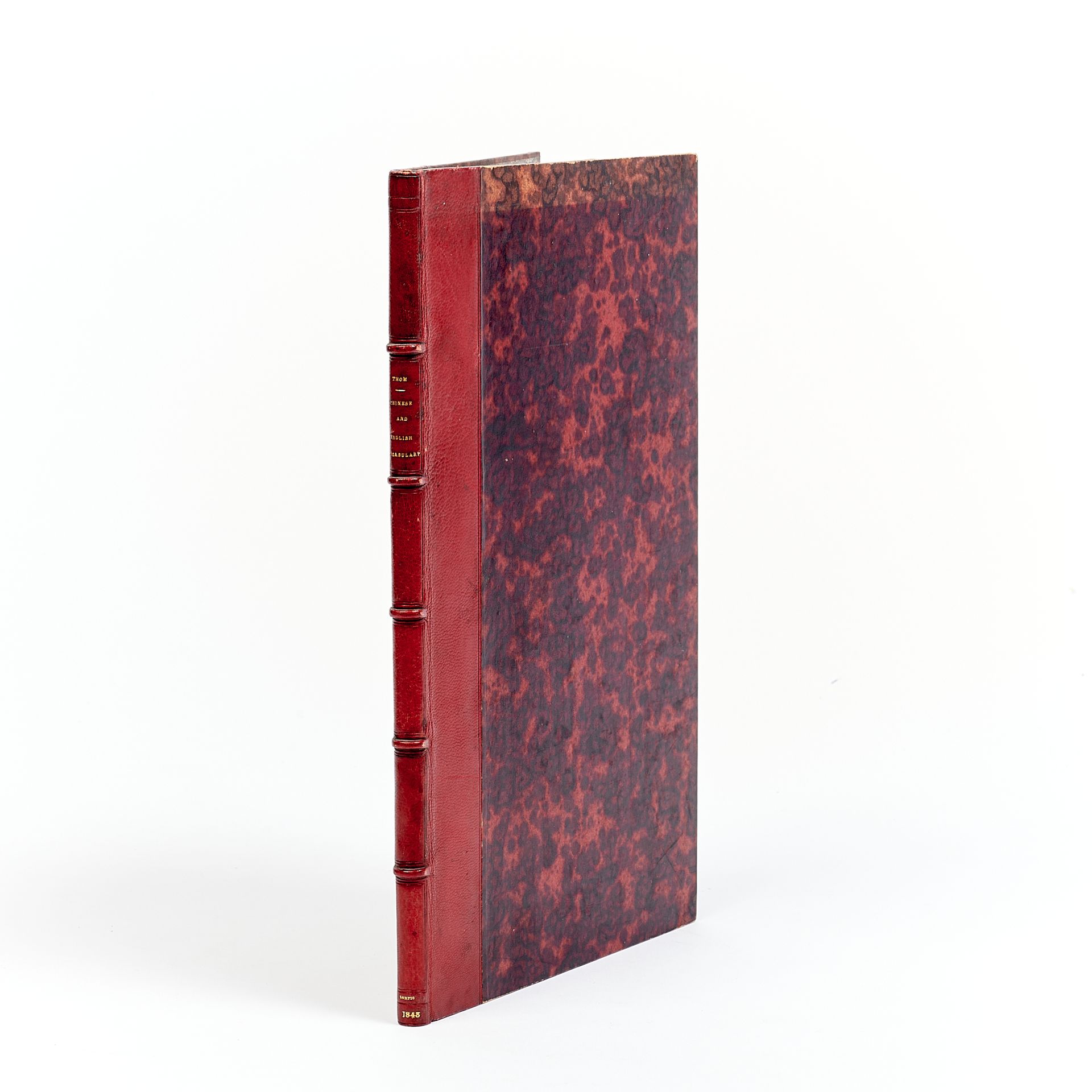
THOM (Robert). Hua Ying tong yong za hua. Shang juan - Chinese and English vocabulary. Part first. S.l, s.n., s.d. [Canton, 1843]. In-8 of 58 oriental printed leaves in English and Chinese, preface in English in facsimile of the author's handwriting on two fold-out leaves. First edition of this rare Franco-Chinese vocabulary by Robert Thom, who learned Mandarin as a representative of Jardine, Matheson Coe in Canton before serving as a translator during the First Opium War. He was one of the first to undertake the literal transcription of Mandarin Chinese into Roman characters, as well as its translation into English. He is considered one of the few Westerners to speak the Beijing dialect, a form of Mandarin unique to the Chinese capital. He is most famous for translating Aesop's Fables into Mandarin. The facsimile reader's advisory is particularly interesting in that it reveals the pioneering nature of the work undertaken by Robert Thom. In it, the author apologizes to the reader for the poor quality of the engraving of the English characters in the book, which are sometimes very difficult to read, as Chinese wood engravers have never before had to reproduce such characters. Bound in red half-maroquin, title, author and date gilt, 5-ribbed spine, bindings underlined with cold fillets, title, author and date gilt, covers preserved, signed Lortic. (some foxing, especially on the edges). Provenance: Natalis Rondot French economist, art historian and silk industrialist, Natalis Rondot was delegated by the Reims Chamber of Commerce to represent France in China during an extraordinary mission to negotiate trade treaties from 1843 to 1846. During this trip, Natalis Rondot became interested in Chinese, Japanese and Indochinese cultures, their silk-working techniques and learned Chinese. On his return, he made a decisive contribution to the development of Lyon's silk industry in the 1850s. Appointed by the Chamber of Commerce in 1856, he founded the Musée d'Art et d'Industrie de Lyon, the future Musée historique des Tissus, which he inaugurated in 1864.
Estimate
€500 - €800
Result
€1,700
Buyer's premium
27%
THOM (Robert). Hua Ying tong yong za hua. Shang juan - Chinese and English vocabulary. Part first. S.l, s.n., s.d. [Canton, 1843].
In-8 of 58 oriental printed leaves in English and Chinese, preface in English in facsimile of the author's handwriting on two fold-out leaves.
First edition of this rare Franco-Chinese vocabulary by Robert Thom, who learned Mandarin as a representative of Jardine, Matheson Coe in Canton before serving as a translator during the First Opium War.
He was one of the first to undertake the literal transcription of Mandarin Chinese into Roman characters, as well as its translation into English. He is considered one of the few Westerners to speak the Beijing dialect, a form of Mandarin unique to the Chinese capital. He is most famous for translating Aesop's Fables into Mandarin.
The facsimile reader's advisory is particularly interesting in that it reveals the pioneering nature of the work undertaken by Robert Thom. In it, the author apologizes to the reader for the poor quality of the engraving of the English characters in the book, which are sometimes very difficult to read, as Chinese wood engravers have never before had to reproduce such characters.
Bound in red half-maroquin, title, author and date gilt, 5-ribbed spine, bindings underlined with cold fillets, title, author and date gilt, covers preserved, signed Lortic.
(some foxing, especially on the edges).
Provenance: Natalis Rondot
French economist, art historian and silk industrialist, Natalis Rondot was delegated by the Reims Chamber of Commerce to represent France in China during an extraordinary mission to negotiate trade treaties from 1843 to 1846. During this trip, Natalis Rondot became interested in Chinese, Japanese and Indochinese cultures, their silk-working techniques and learned Chinese. On his return, he made a decisive contribution to the development of Lyon's silk industry in the 1850s. Appointed by the Chamber of Commerce in 1856, he founded the Musée d'Art et d'Industrie de Lyon, the future Musée historique des Tissus, which he inaugurated in 1864.
Sale
Thursday 31 October 2024・14:00 (Europe/Paris)
Sale location coming soon
1 ter, boulevard de la République
92210 Saint-Cloud