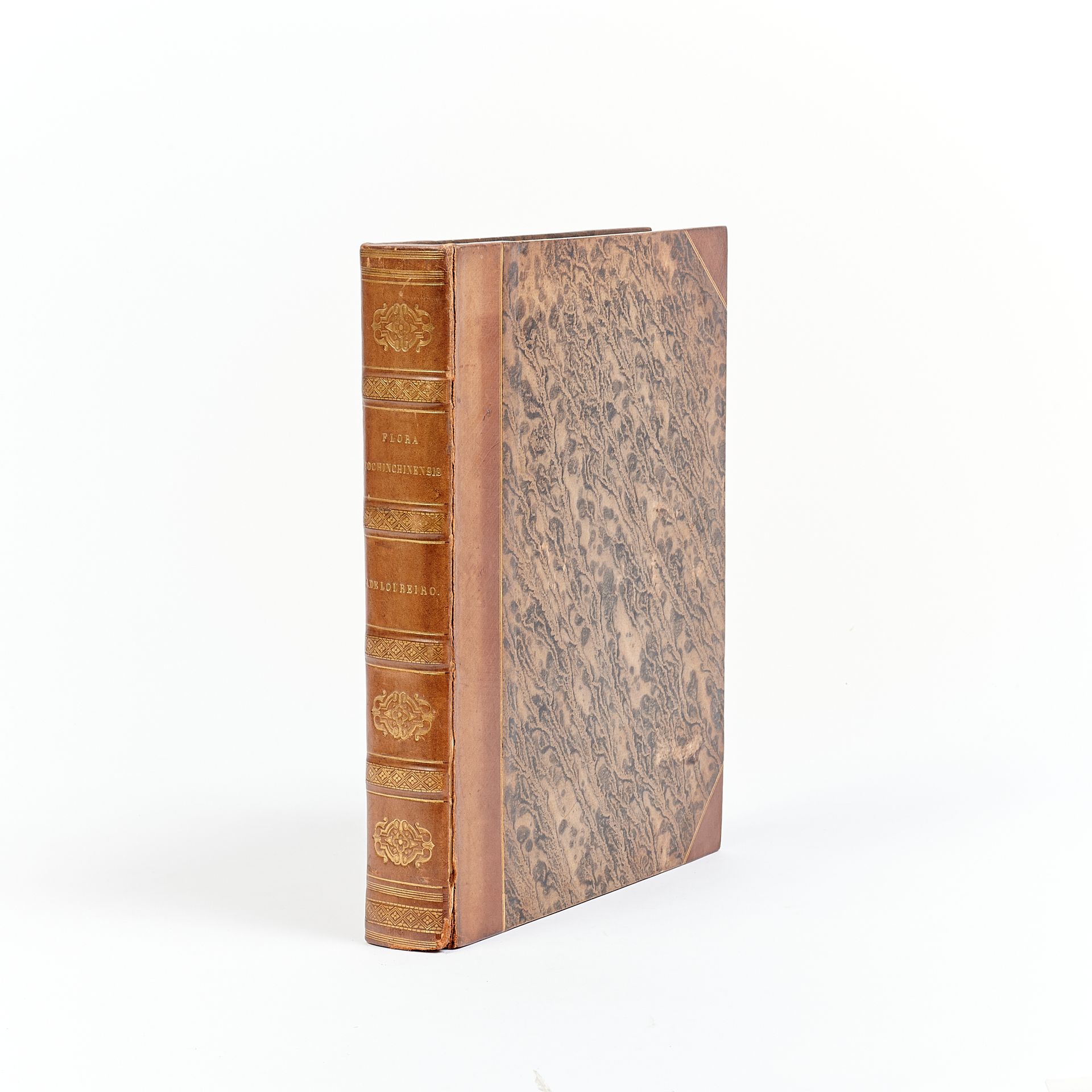
LOUREIRO (João de). Flora Cochinchinensis: sistens plantas in regno Cochinchina nascentes. Ulyssipone [Lisbon], typis academicis, 1790. 2 volumes in one in-4, first edition of one of the most important contributions to the flora of eastern Southeast Asia and southern China by Loureiro, a Portuguese Jesuit missionary and amateur botanist who built up an extensive herbarium and described many new plant genera and species in southern Indochina and Vietnam. Bound in later half-brown calf with corners, spine with 4 raised bands, gilt title and author. Handwritten bookplate and autograph inscription signed by Natalis Rondot "Cédé par Callery, $4, Macao", most certainly Joseph-Marie Callery, French missionary and sinologist born in Turin, who was attached to the Ministry of Foreign Affairs as secretary-interpreter for Chinese. He brought back from Asia several plant species unknown in Europe. Another handwritten inscription in the hand of Aloys Sprenger, an Austrian Orientalist famous for his translations of Hindi, dated April 26, 1840 and located in Paris, indicates the early provenance of Klaproth, probably Julius Klaproth, the famous Prussian Orientalist who originated the theory of the Tibeto-Burman language family. A very interesting copy with the quadruple provenance Klaproth - Sprenger - Callery - Rondot. (upper spine split) French economist, art historian and silk industrialist, Natalis Rondot was delegated by the Reims Chamber of Commerce to represent France in China on an extraordinary mission to negotiate trade treaties from 1843 to 1846. During this trip, Natalis Rondot became interested in Chinese, Japanese and Indochinese cultures, their silk-working techniques and learned Chinese. On his return, he made a decisive contribution to the development of Lyon's silk industry in the 1850s. Appointed by the Chamber of Commerce in 1856, he founded the Musée d'Art et d'Industrie de Lyon, the future Musée historique des Tissus, which he inaugurated in 1864. Expert: Mr Nicolas Asvisio - nicolas.asvisio@gmail.com - 06 47 79 88 52
Estimate
€400 - €600
Result
€700
Buyer's premium
27%
LOUREIRO (João de). Flora Cochinchinensis: sistens plantas in regno Cochinchina nascentes. Ulyssipone [Lisbon], typis academicis, 1790.
2 volumes in one in-4, first edition of one of the most important contributions to the flora of eastern Southeast Asia and southern China by Loureiro, a Portuguese Jesuit missionary and amateur botanist who built up an extensive herbarium and described many new plant genera and species in southern Indochina and Vietnam.
Bound in later half-brown calf with corners, spine with 4 raised bands, gilt title and author.
Handwritten bookplate and autograph inscription signed by Natalis Rondot "Cédé par Callery, $4, Macao", most certainly Joseph-Marie Callery, French missionary and sinologist born in Turin, who was attached to the Ministry of Foreign Affairs as secretary-interpreter for Chinese. He brought back from Asia several plant species unknown in Europe.
Another handwritten inscription in the hand of Aloys Sprenger, an Austrian Orientalist famous for his translations of Hindi, dated April 26, 1840 and located in Paris, indicates the early provenance of Klaproth, probably Julius Klaproth, the famous Prussian Orientalist who originated the theory of the Tibeto-Burman language family.
A very interesting copy with the quadruple provenance Klaproth - Sprenger - Callery - Rondot.
(upper spine split)
French economist, art historian and silk industrialist, Natalis Rondot was delegated by the Reims Chamber of Commerce to represent France in China on an extraordinary mission to negotiate trade treaties from 1843 to 1846. During this trip, Natalis Rondot became interested in Chinese, Japanese and Indochinese cultures, their silk-working techniques and learned Chinese. On his return, he made a decisive contribution to the development of Lyon's silk industry in the 1850s. Appointed by the Chamber of Commerce in 1856, he founded the Musée d'Art et d'Industrie de Lyon, the future Musée historique des Tissus, which he inaugurated in 1864.
Expert: Mr Nicolas Asvisio - nicolas.asvisio@gmail.com - 06 47 79 88 52
Sale
Thursday 31 October 2024・14:00 (Europe/Paris)
Sale location coming soon
1 ter, boulevard de la République
92210 Saint-Cloud