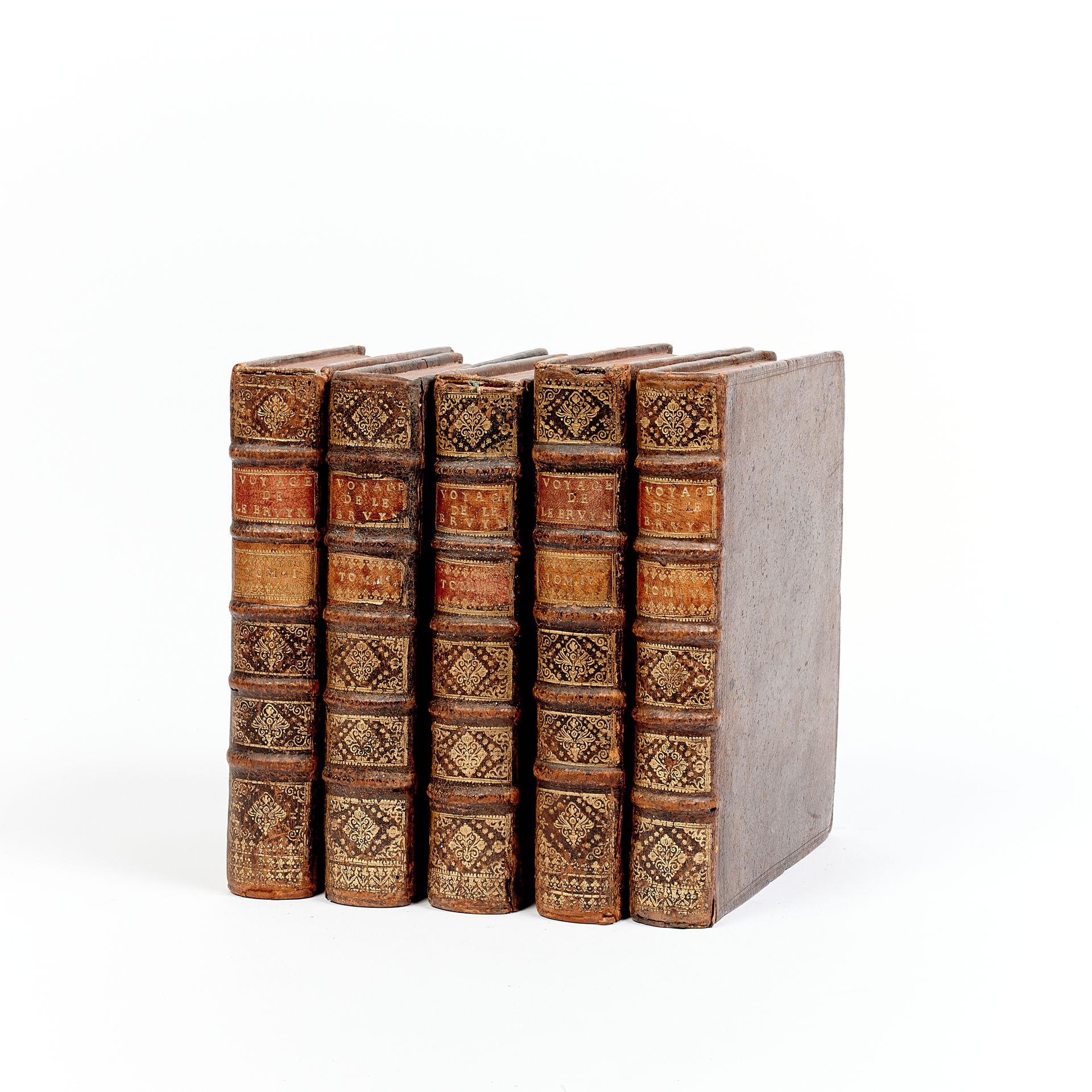
DE BRUYN (Cornelis). Voyage au Levant, i.e. in the principal places of Asia Minor, in the islands of Chio, Rhodes, Cyprus, etc., as well as in the most important cities of Egypt, Syria and the Holy Land. As well as in the most important cities of Egypt, Syria and the Holy Land. - Voyages par la Moscovie, en Perse, et aux Indes orientales. Rouen, Ferrand, 1725. 5 volumes in-4, first collective edition in French of Cornelis De Bruyn's two major travel reports, given by Abbé Antoine Banier, who revised and expanded them with an abridgement of Des Monceaux's then unpublished voyage at the end of the fifth volume. The illustrations include a portrait of the author engraved by Scotin, 5 folding maps and 85 plates out of text, including 14 folding plates, mostly engraved after the author's drawings. Bound in full contemporary brown calf, spine richly decorated with 5 raised bands, red morocco title-pieces. Handwritten bookplate from the library of the Dames de l'Abbbiette, Lille. (some wear to the headpieces and light rubbing, scorched plates, some light scorching, significant wetness in the second volume, tear not missing from the map of the Caspian Sea, small hole in the title-piece of the second volume, beginning of cracks and small wormholes at some joins, angular tear with no damage to the text on pages 301 to 306 and 517 of volume 3, small hole in the plate on page 103 of volume 5). Provenance: Natalis Rondot French economist, art historian and silk industrialist, Natalis Rondot was delegated by the Reims Chamber of Commerce to represent France in China on an extraordinary mission to negotiate trade treaties from 1843 to 1846. During this trip, Natalis Rondot became interested in Chinese, Japanese and Indochinese cultures, their silk-working techniques and learned Chinese. On his return, he made a decisive contribution to the development of Lyon's silk industry in the 1850s. Appointed by the Chamber of Commerce in 1856, he founded the Musée d'Art et d'Industrie de Lyon, the future Musée Historique des Tissus, which he inaugurated in 1864. Expert: Mr Nicolas Asvisio - nicolas.asvisio@gmail.com - 06 47 79 88 52
Estimate
€1,000 - €2,000
Result
€1,600
Buyer's premium
27%
DE BRUYN (Cornelis). Voyage au Levant, i.e. in the principal places of Asia Minor, in the islands of Chio, Rhodes, Cyprus, etc., as well as in the most important cities of Egypt, Syria and the Holy Land. As well as in the most important cities of Egypt, Syria and the Holy Land. - Voyages par la Moscovie, en Perse, et aux Indes orientales. Rouen, Ferrand, 1725.
5 volumes in-4, first collective edition in French of Cornelis De Bruyn's two major travel reports, given by Abbé Antoine Banier, who revised and expanded them with an abridgement of Des Monceaux's then unpublished voyage at the end of the fifth volume.
The illustrations include a portrait of the author engraved by Scotin, 5 folding maps and 85 plates out of text, including 14 folding plates, mostly engraved after the author's drawings.
Bound in full contemporary brown calf, spine richly decorated with 5 raised bands, red morocco title-pieces.
Handwritten bookplate from the library of the Dames de l'Abbbiette, Lille.
(some wear to the headpieces and light rubbing, scorched plates, some light scorching, significant wetness in the second volume, tear not missing from the map of the Caspian Sea, small hole in the title-piece of the second volume, beginning of cracks and small wormholes at some joins, angular tear with no damage to the text on pages 301 to 306 and 517 of volume 3, small hole in the plate on page 103 of volume 5).
Provenance: Natalis Rondot
French economist, art historian and silk industrialist, Natalis Rondot was delegated by the Reims Chamber of Commerce to represent France in China on an extraordinary mission to negotiate trade treaties from 1843 to 1846. During this trip, Natalis Rondot became interested in Chinese, Japanese and Indochinese cultures, their silk-working techniques and learned Chinese. On his return, he made a decisive contribution to the development of Lyon's silk industry in the 1850s. Appointed by the Chamber of Commerce in 1856, he founded the Musée d'Art et d'Industrie de Lyon, the future Musée Historique des Tissus, which he inaugurated in 1864.
Expert: Mr Nicolas Asvisio - nicolas.asvisio@gmail.com - 06 47 79 88 52
Sale
Thursday 31 October 2024・14:00 (Europe/Paris)
Sale location coming soon
1 ter, boulevard de la République
92210 Saint-Cloud