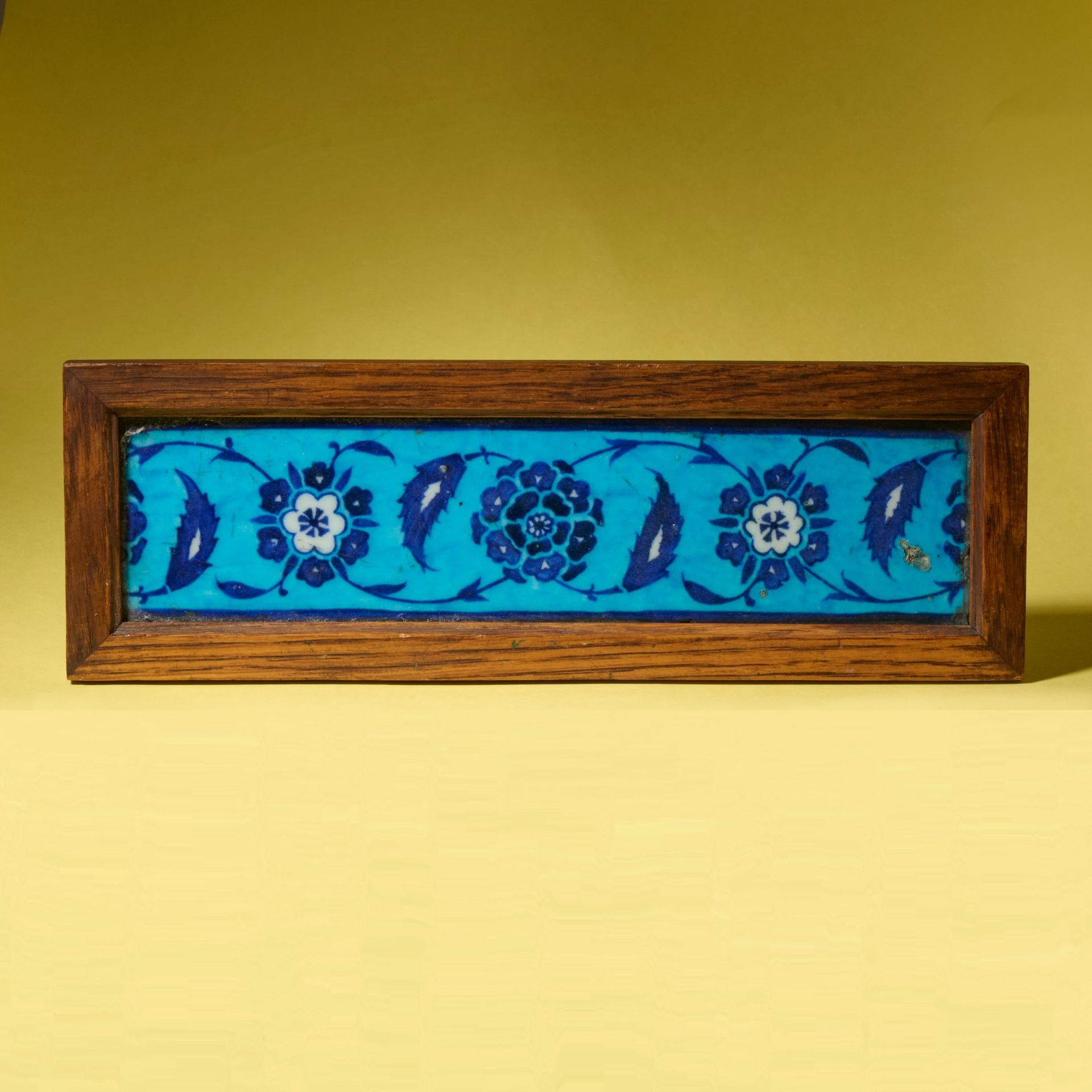
Ottoman TURKEY. Superb rectangular siliceous ceramic facing tile with cobalt blue and white painted decoration on a turquoise ground under a colorless glaze (chips and small scratches), decorated with undulating scrolls of saz palms, rosettes and lotus flowers. In an old wooden frame. Istanbul, circa 1527-28. Height 23.8 cm - Width 6 cm Provenance: Private collection in Ville d'Avray, France. Note: This very fine and rare border tile is similar to those adorning the panels of the façade of the Circumcision Pavilion (Sünnet Odasi), a summer kiosk in the fourth courtyard of the Topkapi Palace in Istanbul, and those of the façade of the Coat Room (Hirka-i Serif Dairesi) (John Carswell, Iznik Pottery, The British Museum Press, London, 1998, fig. 34, pp. 60-61). Among the numerous archives of the centralized Ottoman power, the account books of 1527-28 provide information on the tiles commissioned by Sultan Suleiman the Magnificent and on the production of the Imperial Manufactory of Istanbul to renovate parts of the Topkapi Palace. Around 1550, these workshops could no longer survive in the face of competition from the Iznik workshops, and Ottoman tile production was transferred entirely to Iznik. Expert: Laure Soustiel (tel: 06 09 47 27 31)
Estimate
€2,000 - €3,000
Result
€12,500
Buyer's premium
27%
Ottoman TURKEY.
Superb rectangular siliceous ceramic facing tile with cobalt blue and white painted decoration on a turquoise ground under a colorless glaze (chips and small scratches), decorated with undulating scrolls of saz palms, rosettes and lotus flowers.
In an old wooden frame.
Istanbul, circa 1527-28.
Height 23.8 cm - Width 6 cm
Provenance: Private collection in Ville d'Avray, France.
Note: This very fine and rare border tile is similar to those adorning the panels of the façade of the Circumcision Pavilion (Sünnet Odasi), a summer kiosk in the fourth courtyard of the Topkapi Palace in Istanbul, and those of the façade of the Coat Room (Hirka-i Serif Dairesi) (John Carswell, Iznik Pottery, The British Museum Press, London, 1998, fig. 34, pp. 60-61).
Among the numerous archives of the centralized Ottoman power, the account books of 1527-28 provide information on the tiles commissioned by Sultan Suleiman the Magnificent and on the production of the Imperial Manufactory of Istanbul to renovate parts of the Topkapi Palace. Around 1550, these workshops could no longer survive in the face of competition from the Iznik workshops, and Ottoman tile production was transferred entirely to Iznik.
Expert: Laure Soustiel (tel: 06 09 47 27 31)
Sale
Thursday 31 October 2024・09:30 (Europe/Paris)
Sale location coming soon
1 ter, boulevard de la République
92210 Saint-Cloud