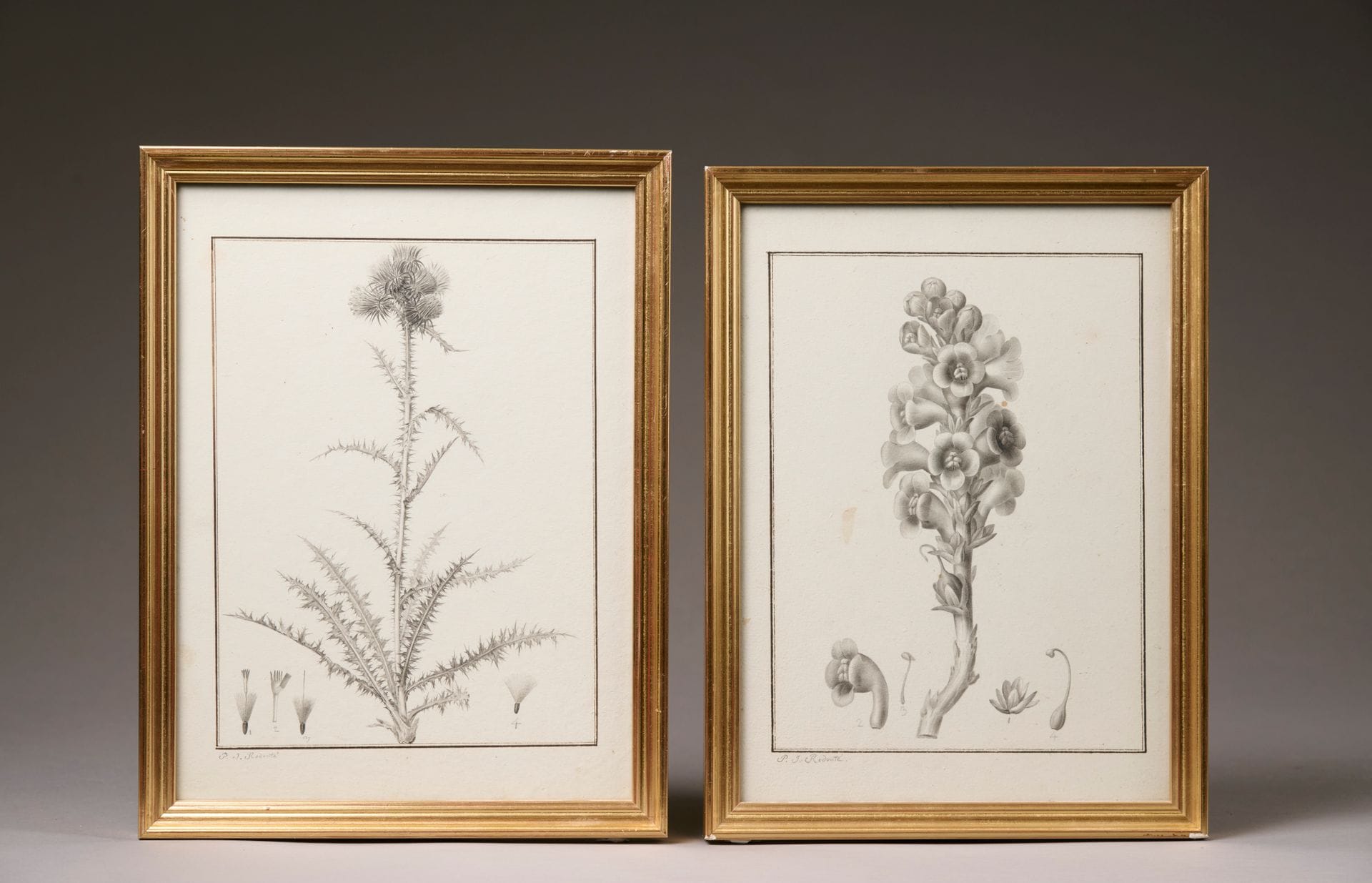
Pierre-Joseph REDOUTÉ (1759-1840). Phelipaea lutea ; Carduus arenarius. Two gray washes over black pencil lines, signed lower left (two stains on either side of the flower for the first). Height 22 cm - Width 17 cm Note: preparatory drawings for engraving respectively pl. 146 and 222 in the volume of plates from Flore Atlantica, Renato Desfontaines, Paris, Pancoucke, year VIII. Nicknamed the "painter of flowers" or "painter of queens". In the 1780s, he turned his attention to the growing discipline of botany. Indeed, a "Flower Salon" was born, and aristocratic ladies became "gardeners", learning botanical nomenclature. After a trip to London to study plants in the royal gardens, Pierre-Joseph Redouté was quickly introduced to Versailles, thanks to his highly precise and delicate technique, and became a protégé of Queen Marie-Antoinette. He received the title of draughtsman and painter to the Queen's Cabinet. He resisted the various political regimes and, from 1798, collaborated with the greatest botanists under the protectorate of Joséphine de Beauharnais, contributing to over fifty works as illustrator and editor. Expert appraisal by de BAYSER - 01 47 03 49 87 - France. info@debayser.com
Estimate
€1,000 - €1,500
Result
€2,200
Buyer's premium
27%
Pierre-Joseph REDOUTÉ (1759-1840).
Phelipaea lutea ;
Carduus arenarius.
Two gray washes over black pencil lines, signed lower left (two stains on either side of the flower for the first).
Height 22 cm - Width 17 cm
Note: preparatory drawings for engraving respectively pl. 146 and 222 in the volume of plates from Flore Atlantica, Renato Desfontaines, Paris, Pancoucke, year VIII.
Nicknamed the "painter of flowers" or "painter of queens".
In the 1780s, he turned his attention to the growing discipline of botany. Indeed, a "Flower Salon" was born, and aristocratic ladies became "gardeners", learning botanical nomenclature. After a trip to London to study plants in the royal gardens, Pierre-Joseph Redouté was quickly introduced to Versailles, thanks to his highly precise and delicate technique, and became a protégé of Queen Marie-Antoinette. He received the title of draughtsman and painter to the Queen's Cabinet.
He resisted the various political regimes and, from 1798, collaborated with the greatest botanists under the protectorate of Joséphine de Beauharnais, contributing to over fifty works as illustrator and editor.
Expert appraisal by de BAYSER - 01 47 03 49 87 - France.
info@debayser.com
Sale
Sunday 13 October 2024・14:30 (Europe/Paris)
Sale location coming soon
1 ter, boulevard de la République
92210 Saint-Cloud