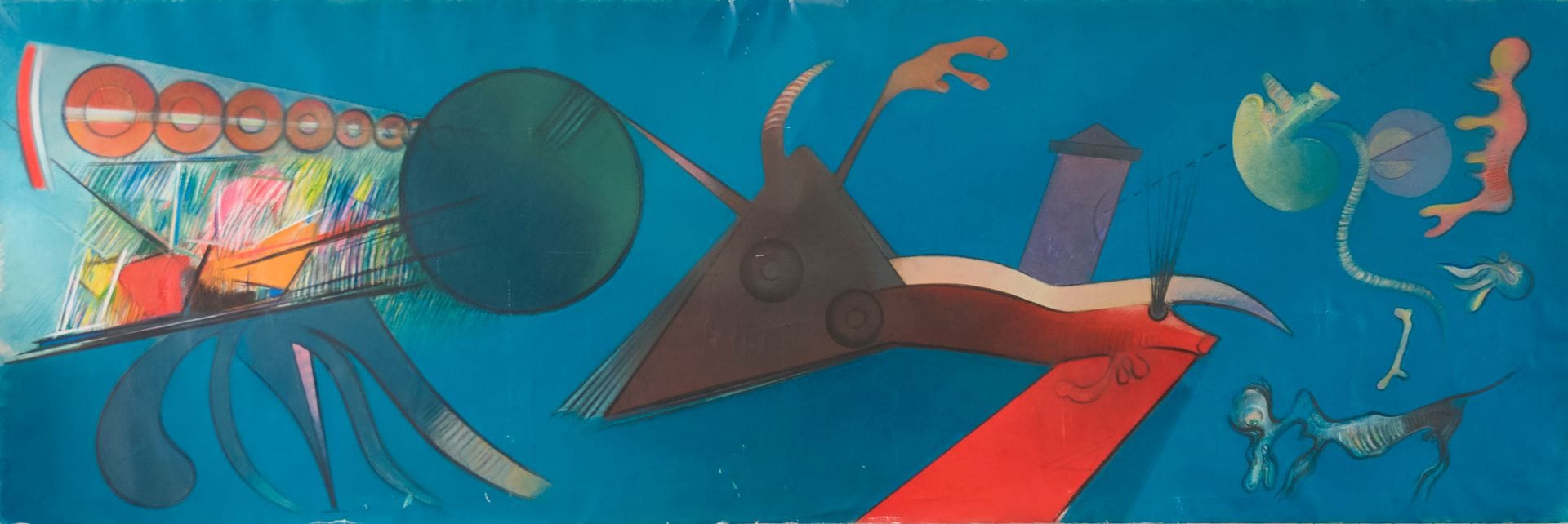
Béla BIRKAS (1929-1973). "Guernica du Vietnam", 1972-1973. Oil on canvas (dents, missing, canvas slack in center). Height : 130 cm 130 cm - Width 392 cm Provenance: Artist's studio Exhibition: Institut Hongrois de Paris, Paris, "Béla Birkàs. Retrospective", October 25 - November 7, 2000. Note: In 1972/1973, towards the end of a conflict that had shaken the entire world for 20 years, Béla Birkas painted "Guernica du Vietnam". This monumental work is one of the finest examples of the artist's humanism. "He never concerned himself with politics, but life had such an important value for him, and he loved human beings with such a pure heart, that he felt he had to protest with his own means against the horrors of the war in Vietnam". Birkas openly quotes Picasso (whom he used to rub shoulders with from time to time in Montparnasse), whose title, format and composition he appropriates for a grandiose surrealist work. Through the abstract forms to which the artist has become accustomed, he incorporates symbols to publicly denounce the scandal of the conflict. On a blue background, the devastating wheels of a tank can be seen on the left, surmounting the chaos caused by war, and on the right, a procession composed of a dog, bones, a skull and tentacles. The main element in the center resembles a mask, a piece of equipment widely used in Vietnam following the introduction of napalm, a deadly gas used as a weapon of war by the Americans. Two hands emerge from the mask: one holds a green bubble like a cannonball, the other turns towards the damage caused by combat. A blood-red flow enveloping a male genitalia expresses the violence of a conflict vainly waged by a foreign power. On the eve of his death, Béla Birkas leaves us the legacy of "Guernica from Vietnam", to awaken human beings to the ravages of war and celebrate the importance of life.
Estimate
€2,000 - €3,000
Result
€2,000
Buyer's premium
27%
Béla BIRKAS (1929-1973).
"Guernica du Vietnam", 1972-1973.
Oil on canvas (dents, missing, canvas slack in center).
Height : 130 cm 130 cm - Width 392 cm
Provenance: Artist's studio
Exhibition: Institut Hongrois de Paris, Paris, "Béla Birkàs. Retrospective", October 25 - November 7, 2000.
Note: In 1972/1973, towards the end of a conflict that had shaken the entire world for 20 years, Béla Birkas painted "Guernica du Vietnam". This monumental work is one of the finest examples of the artist's humanism. "He never concerned himself with politics, but life had such an important value for him, and he loved human beings with such a pure heart, that he felt he had to protest with his own means against the horrors of the war in Vietnam". Birkas openly quotes Picasso (whom he used to rub shoulders with from time to time in Montparnasse), whose title, format and composition he appropriates for a grandiose surrealist work. Through the abstract forms to which the artist has become accustomed, he incorporates symbols to publicly denounce the scandal of the conflict. On a blue background, the devastating wheels of a tank can be seen on the left, surmounting the chaos caused by war, and on the right, a procession composed of a dog, bones, a skull and tentacles. The main element in the center resembles a mask, a piece of equipment widely used in Vietnam following the introduction of napalm, a deadly gas used as a weapon of war by the Americans. Two hands emerge from the mask: one holds a green bubble like a cannonball, the other turns towards the damage caused by combat. A blood-red flow enveloping a male genitalia expresses the violence of a conflict vainly waged by a foreign power. On the eve of his death, Béla Birkas leaves us the legacy of "Guernica from Vietnam", to awaken human beings to the ravages of war and celebrate the importance of life.
Sale
Thursday 26 September 2024・09:30 (Europe/Paris)
Sale location coming soon
1 ter, boulevard de la République
92210 Saint-Cloud