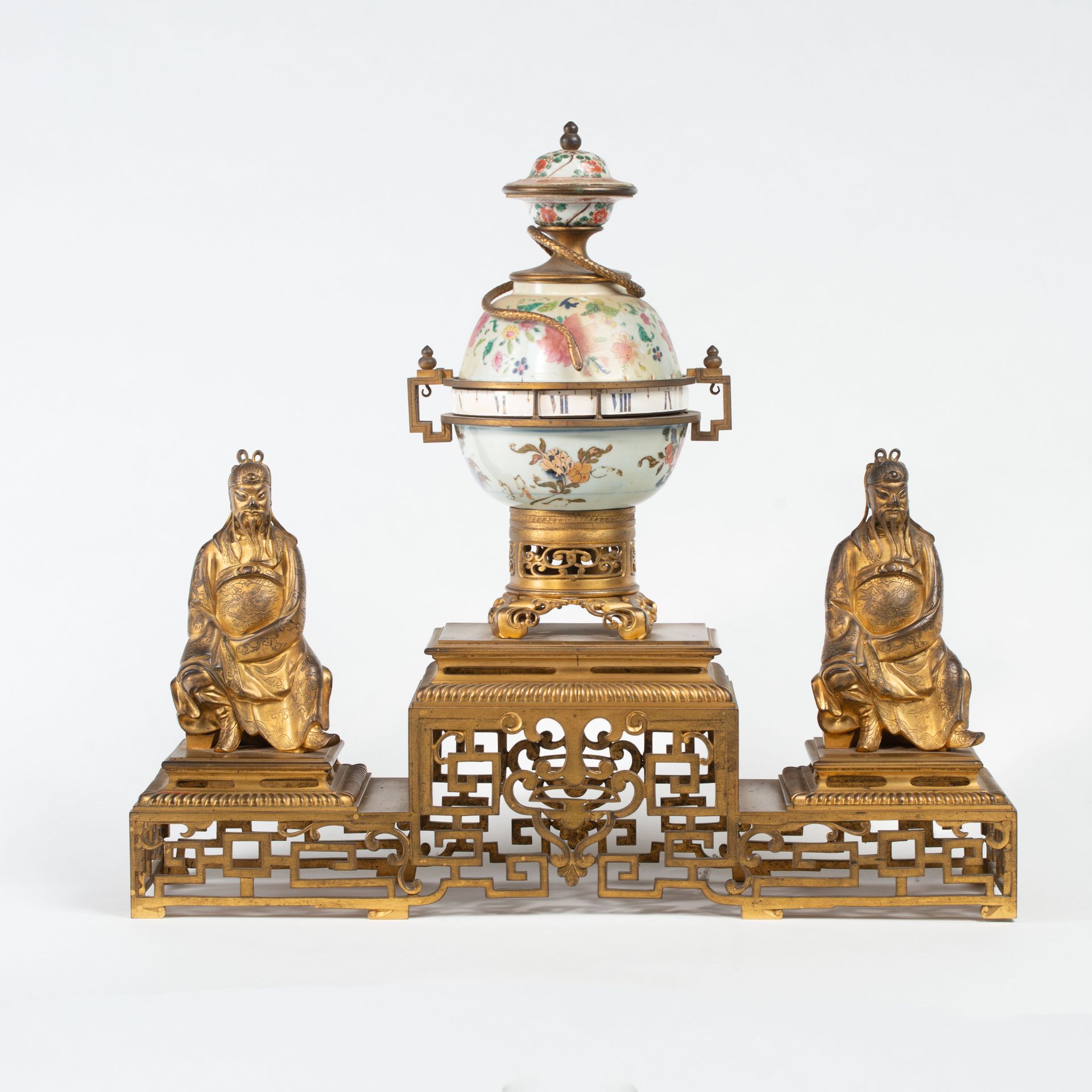
Chased and gilded bronze revolving dial clock, the base with geometric day decoration forming a tier, supporting a seated scholar on each side and in the center, the movement inserted in Chinese porcelain bowls with white background (one reported), a snake indicating the time. The dial features Roman numerals in blue and quarters and halves in gilded (worn and missing). Attributed to L'Escalier de Cristal. Late 19th century. Height 51 cm - Width 56.5 cm - Depth 17 cm Note : The 1867 Paris World's Fair, with its Japanese pavilion, brought chinoiserie, and more particularly Japonisme, back into fashion among French and international customers. The L'Escalier de Cristal store opened around 1808 in the garden galleries of the Palais-Royal, specializing in the sale of glass and ceramic objets d'art, as well as bronze furniture and sculptures. From 1850 onwards, L'Escalier de Cristal took part in the World's Fairs, winning several awards, including a gold medal at the 1900 Paris Exposition Universelle. In 1863, the company moved to the Opéra district. Among the many artists who collaborated with L'Escalier de Cristal were Gabriel Viardot, Emile Gallé, François-Eugène Rousseau and Majorelle. Appraisal by Cédric HÉNON - 06 95 34 93 78 - cedric.henon@authenticite.fr
Estimate
€3,000 - €6,000
Result
€3,000
Buyer's premium
27%
Chased and gilded bronze revolving dial clock, the base with geometric day decoration forming a tier, supporting a seated scholar on each side and in the center, the movement inserted in Chinese porcelain bowls with white background (one reported), a snake indicating the time. The dial features Roman numerals in blue and quarters and halves in gilded (worn and missing).
Attributed to L'Escalier de Cristal.
Late 19th century.
Height 51 cm - Width 56.5 cm - Depth 17 cm
Note :
The 1867 Paris World's Fair, with its Japanese pavilion, brought chinoiserie, and more particularly Japonisme, back into fashion among French and international customers.
The L'Escalier de Cristal store opened around 1808 in the garden galleries of the Palais-Royal, specializing in the sale of glass and ceramic objets d'art, as well as bronze furniture and sculptures.
From 1850 onwards, L'Escalier de Cristal took part in the World's Fairs, winning several awards, including a gold medal at the 1900 Paris Exposition Universelle.
In 1863, the company moved to the Opéra district.
Among the many artists who collaborated with L'Escalier de Cristal were Gabriel Viardot, Emile Gallé, François-Eugène Rousseau and Majorelle.
Appraisal by Cédric HÉNON - 06 95 34 93 78 - cedric.henon@authenticite.fr
Sale
Sunday 8 October 2023・14:00 (Europe/Paris)
Sale location coming soon
1 ter, boulevard de la République
92210 Saint-Cloud