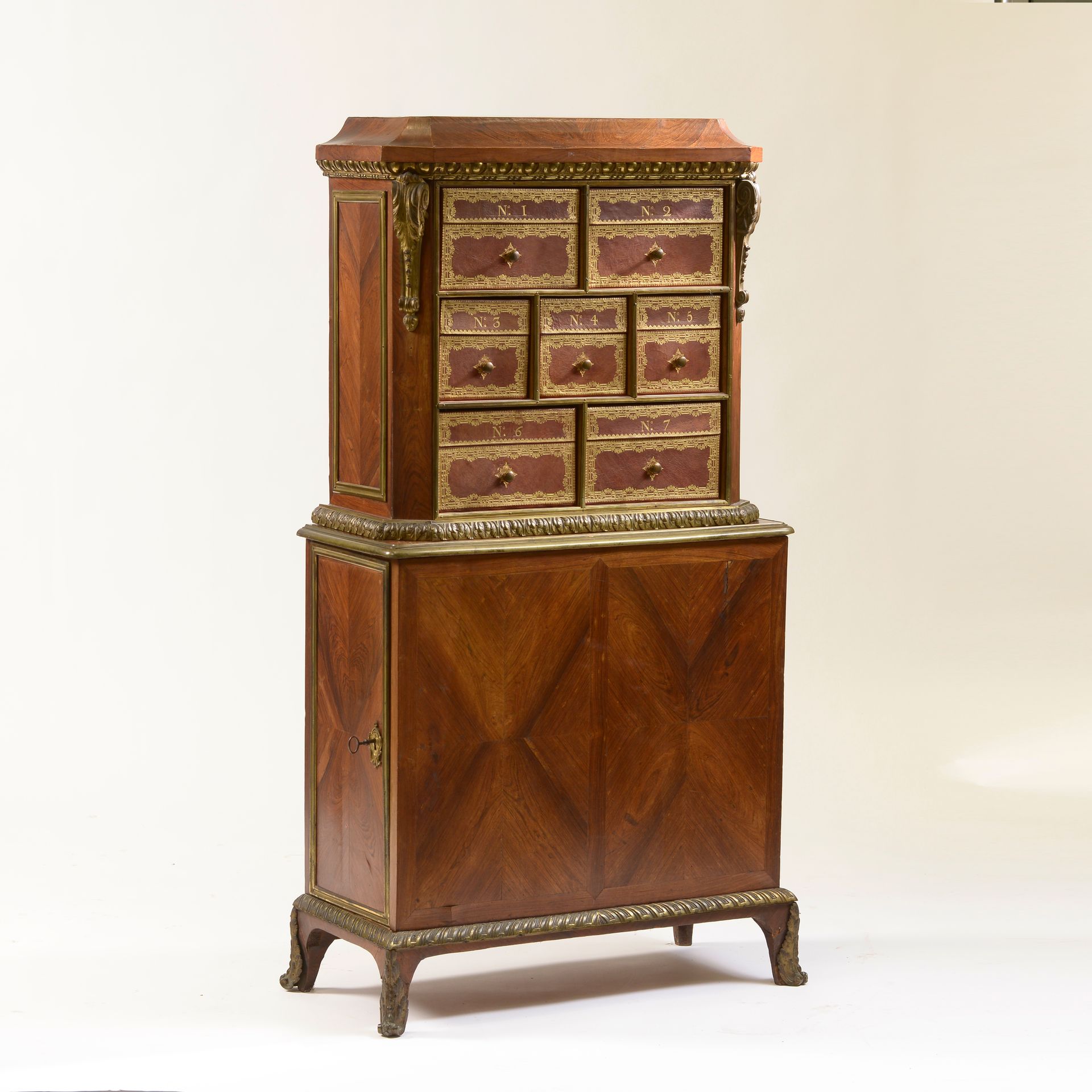
Cartonnier and base in rosewood veneer and violet wood veneer. The canted cartonnier features seven Moroccan-style drawers on three registers and is topped with a doucine. Richly ornamented with chased and gilded bronzes, such as foliate and floral console falls, lateral framing strips, wide quarter rounds with ovals, pearls and olives at the top and foliate at the bottom. The quadrangular base opens with two side panels and rests on four cambered legs (old replacage, lifts and restorations). Chased and gilded bronze sabots, framing rods and key escutcheons. Each piece stamped several times by Pierre GARNIER, received master December 31, 1742, and once by Bon DURAN, received master February 18, 1761. Circa 1760-1770. Label affixed to the back: Ets CHENU. Height : 143 cm - Width : 78 cm - Depth : 36 cm Provenance : - Bernard Dillée collection, then by descent. - Sale Maître Ader, Hôtel Drouot, November 14, 1934, lot 94. - René Valadon Collection. Exhibition: -Musée des Arts Décoratifs, UCAD, Paris, 1955-1956. Bibliography: - Christophe Huchet de Quénetain, Pierre Garnier, Les Editions de l'Amateur, 2003, described p. 74 and listed under No. 28. - Isabel Pereira Coutinho, 18th century French Furniture. Lisbon: Calouste Gulbenkian Museum, 1999, pp. 191-197. - Alexandre Pradère, Les Ebénistes Français de Louis XIV à la Révolution, Chêne, 1992, p. 246 to 251. - Catalog of the Musée des Arts Décoratifs Exhibition, 1955-1956, No. 113. - Shelley M. Bennett and Carolyn Sargentson, French Art of the Eighteenth Century at The Huntington, Yale, 2008, pp. 88-89. - François de Salverte, Les Ebénistes du XVIIIe siècle, De Nobele, 1975. Note: A precursor of French neoclassicism, Pierre Garnier (circa 1720-1800) worked for the major Parisian clients of the second half of the 18th century, in particular the Marquis de Marigny, for whom he supplied numerous neoclassical pieces to furnish his apartments at the Hôtel de Massiac. Our cartonnier is part of Garnier's neoclassical production, which includes five flat desks and two cartonniers: -a cartonnier currently in the Calouste Gulbenkian Museum in Lisbon, featuring the cut sides and two quarter-round bronzes (Isabel Pereira Coutinho, 18th century French Furniture. Lisbon: Calouste Gulbenkian Museum, 1999, pp. 191-197). -A cartonnier from the former collection of the Duc de Talleyrand, Valençay et Sagan at the Château de Sagan, sale, Galerie Georges Petit, May 29 to June 1, 1899, lot no.: 272. These two cardboard boxes feature the cut sides and doucine top. The creation of this series of cartonniers must be linked to the creation of a series of five flat desks, the first two of which had an identified cartonnier: - a flat desk, Calouste Gulbenkian Museum, Lisbon. - a flat desk, former Talleyrand Collection. - a flat desk, The Huntington Collection, California. - a flat desk, Marquis of Bath Collection, Longleat. - a flat desk, former Stavros S. Niarchos, Paris. The association of the underframe and our cartonnier may seem surprising, but the presence of the two stamps P. Garnier and B. Durant on each element, we can confirm that they were born at the same time. The neoclassical period saw a natural blending of styles. Bon Durant's stamp can be found on many of Pierre Garnier's creations from the 1760s onwards, including furniture delivered to the Château de Montgeoffroy for the Maréchal de Contades, as well as a pair of commodes dated 1768, in the collections of the King of Sweden, Château de Gripsholm. Unlike B. Durant, Pierre Garnier stamped each piece of furniture several times and in a highly visible manner. Durant. Pierre Garnier frequently subcontracted his major orders to Durant, as shown by the presence of a register spanning more than nine years, rather than mere receivables. Expertise carried out by Mr. Cédric HÉNON - 06 95 34 93 78 - cedric.henon@authenticite.fr
Estimate
€7,000 - €9,000
Result
€18,000
Buyer's premium
27%
Cartonnier and base in rosewood veneer and violet wood veneer. The canted cartonnier features seven Moroccan-style drawers on three registers and is topped with a doucine. Richly ornamented with chased and gilded bronzes, such as foliate and floral console falls, lateral framing strips, wide quarter rounds with ovals, pearls and olives at the top and foliate at the bottom. The quadrangular base opens with two side panels and rests on four cambered legs (old replacage, lifts and restorations). Chased and gilded bronze sabots, framing rods and key escutcheons.
Each piece stamped several times by Pierre GARNIER, received master December 31, 1742, and once by Bon DURAN, received master February 18, 1761.
Circa 1760-1770.
Label affixed to the back: Ets CHENU.
Height : 143 cm - Width : 78 cm - Depth : 36 cm
Provenance :
- Bernard Dillée collection, then by descent.
- Sale Maître Ader, Hôtel Drouot, November 14, 1934, lot 94.
- René Valadon Collection.
Exhibition:
-Musée des Arts Décoratifs, UCAD, Paris, 1955-1956.
Bibliography:
- Christophe Huchet de Quénetain, Pierre Garnier, Les Editions de l'Amateur, 2003, described p. 74 and listed under No. 28.
- Isabel Pereira Coutinho, 18th century French Furniture. Lisbon: Calouste Gulbenkian Museum, 1999, pp. 191-197.
- Alexandre Pradère, Les Ebénistes Français de Louis XIV à la Révolution, Chêne, 1992, p. 246 to 251.
- Catalog of the Musée des Arts Décoratifs Exhibition, 1955-1956, No. 113.
- Shelley M. Bennett and Carolyn Sargentson, French Art of the Eighteenth Century at The Huntington, Yale, 2008, pp. 88-89.
- François de Salverte, Les Ebénistes du XVIIIe siècle, De Nobele, 1975.
Note:
A precursor of French neoclassicism, Pierre Garnier (circa 1720-1800) worked for the major Parisian clients of the second half of the 18th century, in particular the Marquis de Marigny, for whom he supplied numerous neoclassical pieces to furnish his apartments at the Hôtel de Massiac.
Our cartonnier is part of Garnier's neoclassical production, which includes five flat desks and two cartonniers:
-a cartonnier currently in the Calouste Gulbenkian Museum in Lisbon, featuring the cut sides and two quarter-round bronzes (Isabel Pereira Coutinho, 18th century French Furniture. Lisbon: Calouste Gulbenkian Museum, 1999, pp. 191-197).
-A cartonnier from the former collection of the Duc de Talleyrand, Valençay et Sagan at the Château de Sagan, sale, Galerie Georges Petit, May 29 to June 1, 1899, lot no.: 272.
These two cardboard boxes feature the cut sides and doucine top.
The creation of this series of cartonniers must be linked to the creation of a series of five flat desks, the first two of which had an identified cartonnier:
- a flat desk, Calouste Gulbenkian Museum, Lisbon.
- a flat desk, former Talleyrand Collection.
- a flat desk, The Huntington Collection, California.
- a flat desk, Marquis of Bath Collection, Longleat.
- a flat desk, former Stavros S. Niarchos, Paris.
The association of the underframe and our cartonnier may seem surprising, but the presence of the two stamps P. Garnier and B. Durant on each element, we can confirm that they were born at the same time. The neoclassical period saw a natural blending of styles.
Bon Durant's stamp can be found on many of Pierre Garnier's creations from the 1760s onwards, including furniture delivered to the Château de Montgeoffroy for the Maréchal de Contades, as well as a pair of commodes dated 1768, in the collections of the King of Sweden, Château de Gripsholm.
Unlike B. Durant, Pierre Garnier stamped each piece of furniture several times and in a highly visible manner. Durant. Pierre Garnier frequently subcontracted his major orders to Durant, as shown by the presence of a register spanning more than nine years, rather than mere receivables.
Expertise carried out by Mr. Cédric HÉNON - 06 95 34 93 78 - cedric.henon@authenticite.fr
Sale
Sunday 8 October 2023・14:00 (Europe/Paris)
Sale location coming soon
1 ter, boulevard de la République
92210 Saint-Cloud