Cartonnier clock in violet wood veneer. Extensive ornamentation in chased ormolu, partly stamped with a crowned C. White enameled dial with blue Roman numerals for the hours and black Arabic numerals for the minutes, and gilded fleurs-de-lis (cracks, chips and restorations). The dial and movement, numbered 2864, are signed Jean-Baptiste BAILLON A Paris. Attributed to Charles CRESSENT. Louis XV period. Height 39 cm - Width 56 cm - Depth 13.5 cm Provenance : -Former Bernard Dillée collection, then by descent. -Sale Maître Ader, Palais Galliera, November 23, 1965, lot 69, reproduced. Bibliography : -Pierre Kjellberg, Le goût d'un expert, Connaissance des Arts, May 1969, n°207, reproduced p. 75. -Alexandre Pradère, Charles Cressent, sculpteur, ébéniste du Régent, Dijon, 2003, reproduced p. 301, fig. 244. -Alvar Gonzalez-Palacios, Gli Arredi Francesi, Il Patrimonio del Quirinale, Milan, 1995, p. 296, fig. 79. Note: Charles Cressent (1685-1768) was one of the few cabinetmakers of his time to be mentioned in sales catalogs. Only two other examples comparable to our clock are known, both in violet wood veneer: -one now in the Palazzo del Quirinale in Rome, from the Royal Palace in Genoa, with a dial signed Jean-Baptiste Baillon and bronzes hallmarked with a crowned C (A. Gonzalez-Palacios, op. cit., p. 296, no. 79 and A. Pradère, op. cit., p.301, fig. 243). -the second, Sotheby's Paris sale November 7, 2013, lot 171, with a dial and movement signed Julien Le Roy de La Société des Arts. Charles Cressent's initial training as a sculptor enabled him to produce highly original gilded bronzes, and by 1723 he had taken on the title of cabinetmaker to the Regent. The presence of the crowned C allows us to date our clock to between 1745 and 1749, the period during which this tax was introduced. The quality of the casting and chasing testifies to Charles Cressent's mastery of this art, which earned him several lawsuits with the guild of founders and gilders at the time. Jean-Baptiste III Baillon: awarded the title of Master on February 14, 1727, he became the Queen's valet de chambre-horloger ordinaire in 1738. Appraisal by Mr. Cédric HÉNON - 06 95 34 93 78 - cedric.henon@authenticite.fr
Estimate
€20,000 - €30,000
Result
€34,500
Buyer's premium
27%
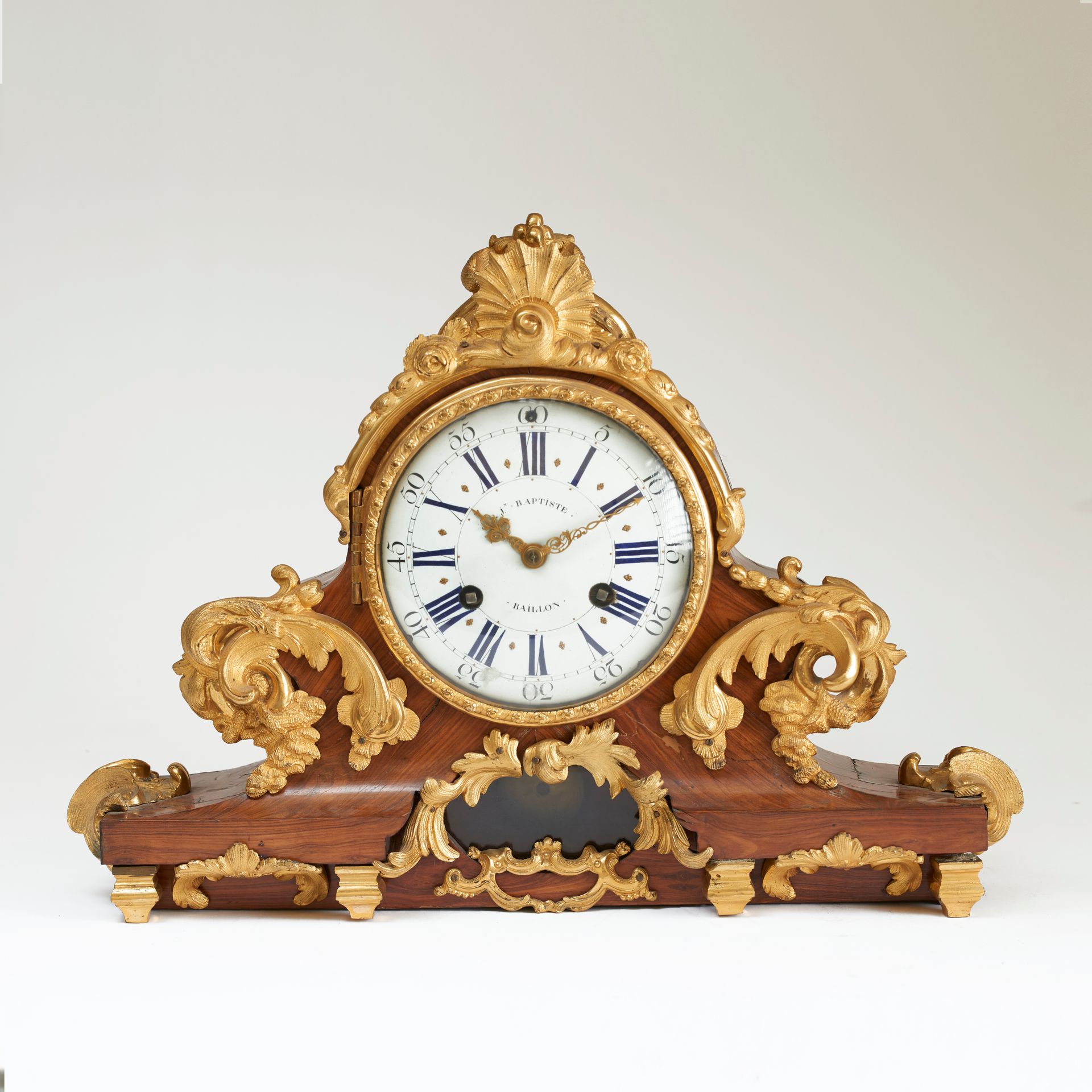
Cartonnier clock in violet wood veneer. Extensive ornamentation in chased ormolu, partly stamped with a crowned C. White enameled dial with blue Roman numerals for the hours and black Arabic numerals for the minutes, and gilded fleurs-de-lis (cracks, chips and restorations).
The dial and movement, numbered 2864, are signed Jean-Baptiste BAILLON A Paris.
Attributed to Charles CRESSENT.
Louis XV period.
Height 39 cm - Width 56 cm - Depth 13.5 cm
Provenance :
-Former Bernard Dillée collection, then by descent.
-Sale Maître Ader, Palais Galliera, November 23, 1965, lot 69, reproduced.
Bibliography :
-Pierre Kjellberg, Le goût d'un expert, Connaissance des Arts, May 1969, n°207, reproduced p. 75.
-Alexandre Pradère, Charles Cressent, sculpteur, ébéniste du Régent, Dijon, 2003, reproduced p. 301, fig. 244.
-Alvar Gonzalez-Palacios, Gli Arredi Francesi, Il Patrimonio del Quirinale, Milan, 1995, p. 296, fig. 79.
Note:
Charles Cressent (1685-1768) was one of the few cabinetmakers of his time to be mentioned in sales catalogs.
Only two other examples comparable to our clock are known, both in violet wood veneer:
-one now in the Palazzo del Quirinale in Rome, from the Royal Palace in Genoa, with a dial signed Jean-Baptiste Baillon and bronzes hallmarked with a crowned C (A. Gonzalez-Palacios, op. cit., p. 296, no. 79 and A. Pradère, op. cit., p.301, fig. 243).
-the second, Sotheby's Paris sale November 7, 2013, lot 171, with a dial and movement signed Julien Le Roy de La Société des Arts.
Charles Cressent's initial training as a sculptor enabled him to produce highly original gilded bronzes, and by 1723 he had taken on the title of cabinetmaker to the Regent.
The presence of the crowned C allows us to date our clock to between 1745 and 1749, the period during which this tax was introduced. The quality of the casting and chasing testifies to Charles Cressent's mastery of this art, which earned him several lawsuits with the guild of founders and gilders at the time.
Jean-Baptiste III Baillon: awarded the title of Master on February 14, 1727, he became the Queen's valet de chambre-horloger ordinaire in 1738.
Appraisal by Mr. Cédric HÉNON - 06 95 34 93 78 - cedric.henon@authenticite.fr
Sale
Sunday 8 October 2023・14:00 (Europe/Paris)
Sale location coming soon
1 ter, boulevard de la République
92210 Saint-Cloud