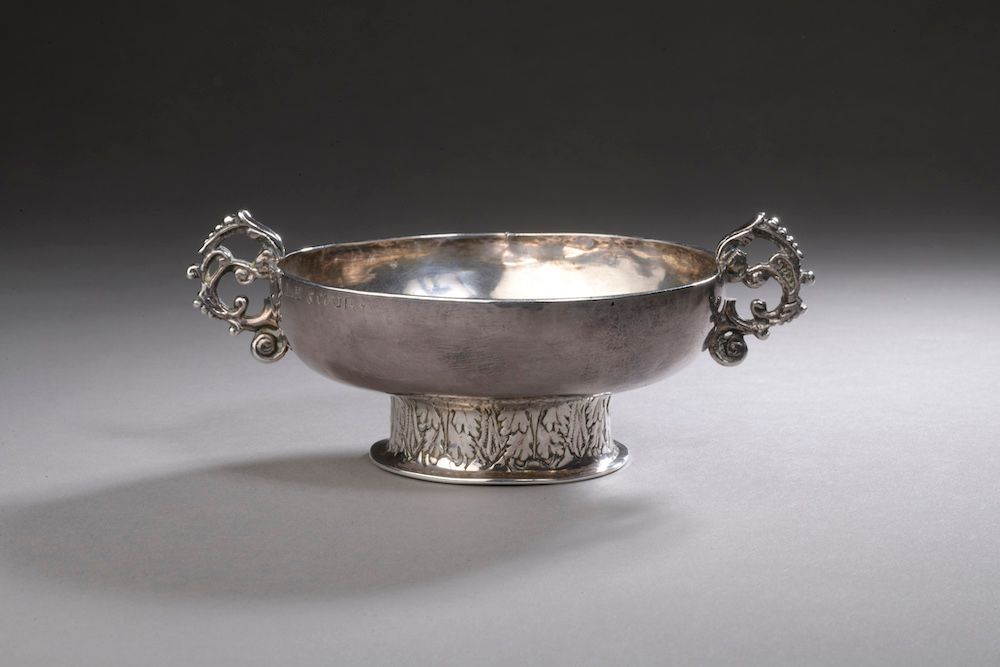
Silver wedding cup, the handles decorated with foliage, resting on a pedestal decorated with acanthus leaves, the neck engraved J. Le Scour (slight shocks and deformations, slight crack in the neck). Morlaix, 1704-1706. Master Goldsmith : Thomas MAILLARD (circa 1687-1718). Height : 6 cm. 6 cm - Length : 14 cm - Weight : 140,1 g Goldsmith of the Jurande de Morlaix, Thomas Maillard is listed for the first time in 1687 for the realization of a dish for the church of Roscoff. Active until 1717, he is particularly famous for the realization of the treasure of Saint-Jean du-Doigt, whose monstrance and ciborium are today classified as historical monuments. Dated between 1704 and 1706, our wedding cup is all the more precious as it has survived the numerous public melting operations that took place throughout the 18th century. Indeed, in 1689, Louis XIV issued a melting ordinance and ordered the transport to the Mint of silver and gold furniture and objects to meet the expenses generated by the war of the League of Augsburg. The operation was repeated on a large scale in 1709 to cope with the famine and the Spanish War. These two events marked a turning point in the history of French decorative arts, with porcelain tending to replace precious metals at the top of French production. This cup is therefore one of the very rare examples of civil silverware from the Louis XIV period, having survived the great melting of 1709 and the equally important ones that followed under Louis XV and during the Revolution.
Estimate
€1,000 - €2,000
Result
€1,200
Buyer's premium
25%
Silver wedding cup, the handles decorated with foliage, resting on a pedestal decorated with acanthus leaves, the neck engraved J. Le Scour (slight shocks and deformations, slight crack in the neck).
Morlaix, 1704-1706.
Master Goldsmith : Thomas MAILLARD (circa 1687-1718).
Height : 6 cm. 6 cm - Length : 14 cm - Weight : 140,1 g
Goldsmith of the Jurande de Morlaix, Thomas Maillard is listed for the first time in 1687 for the realization of a dish for the church of Roscoff. Active until 1717, he is particularly famous for the realization of the treasure of Saint-Jean du-Doigt, whose monstrance and ciborium are today classified as historical monuments. Dated between 1704 and 1706, our wedding cup is all the more precious as it has survived the numerous public melting operations that took place throughout the 18th century.
Indeed, in 1689, Louis XIV issued a melting ordinance and ordered the transport to the Mint of silver and gold furniture and objects to meet the expenses generated by the war of the League of Augsburg. The operation was repeated on a large scale in 1709 to cope with the famine and the Spanish War. These two events marked a turning point in the history of French decorative arts, with porcelain tending to replace precious metals at the top of French production. This cup is therefore one of the very rare examples of civil silverware from the Louis XIV period, having survived the great melting of 1709 and the equally important ones that followed under Louis XV and during the Revolution.
Sale
Sunday 9 May 2021・14:00 (Europe/Paris)
Sale location coming soon
1 ter, boulevard de la République
92210 Saint-Cloud