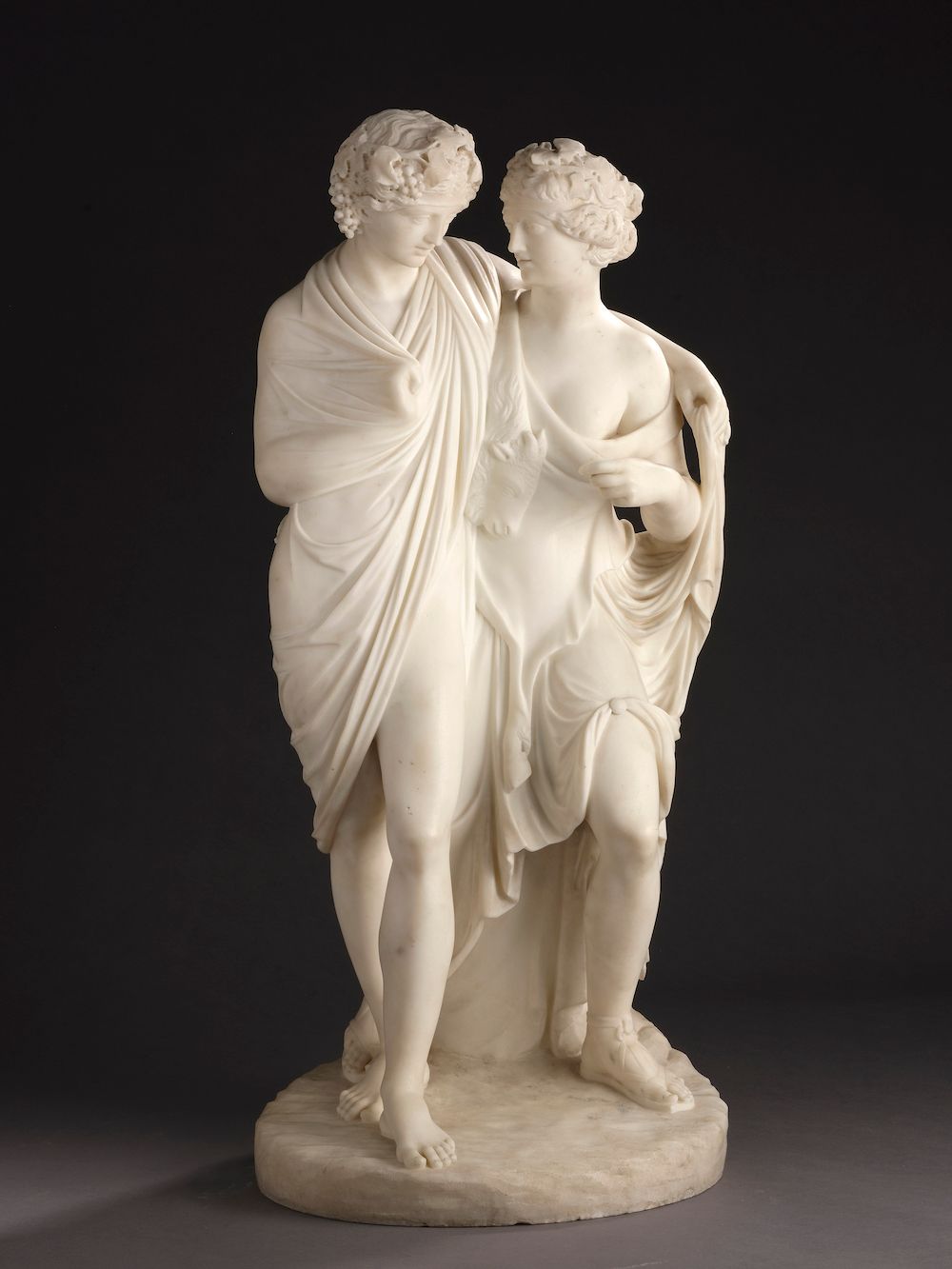
Italian school, around 1800, surrounded by Carlo Albacini (1734 - 1813). Bacchus and Ariadne. Group carved in white marble (tiny chips, restorations on Ariadne's left index finger). High. 71.5 cm - Width: 32 cm The work of an Italian artist, this marble depicting Bacchus and Ariadne was inspired by a Greco-Roman copy of the 1st and 2nd centuries A.D. It illustrates the "Return to Antiquity" whose success is expressed in the numerous restorations of archaeological works that multiplied and irrigated artistic creation in Rome at the end of the 18th century. The Roman copy originally consisted of the torsos of two figures and part of the drapery. The work is then identified as Priape and a menade. The group is restored and "reconstituted". A sculptor adds the faces and the group becomes Bacchus and Ariadne. In the 1770s, it entered the Smith Barry collection and became part of Marbury Hall Castle in Cheshire, England. As early as 1777, Francesco Carradori, a master specialized in the restoration of archaeological works, created a group strongly inspired by the Roman copy but whose work on the drapes, the detail of the goat's head and the sandals set a more elegant model adapted to the neoclassical taste of the European aristocracy making the Grand Tour. Thus, this marble is exemplary of neoclassical aesthetics, by its ancient origin and by the creativity of the sculptor who perfectly links these two figures in the manner of Antonio Canova's standing groups (see Daedalus and Icarus or Venus and Adonis). This marble represents a moment of tender complicity illustrating the ability of neoclassical sculptors to detach themselves from ancient rigour in order to introduce an ideal of softness into their works. These two figures are not simply next to each other, but marry through the fusion of their drapes, through the play of glances and through the embracing gesture of Bacchus. It is all these elements of neoclassical taste that many Italian artists of the 19th century enjoyed sculpting in this group, such as Francesco Carradori (1747-1824) or Carlo Albacini (1770-1807), a number of works attributed to him having the same dimensions as our work. Related works : - Bacchus and Ariadne, Greco-Roman copy, Rome, Imperial Period, ca. 1-2th century B.C. and 18th century restorations, marble sculpture, Boston Fine Arts Museum, N°inv.68.770 ; - Francesco Carradori (1747-1824), Bacchus and Ariadne, ca. 1777, marble sculpture, Florence, Palazzo Pitti, Galleria Palatina; - Carlo Albacini (Fabriano, 1734 - Rome, 1813), Italian School c. 1800, Bacchus and Ariadne, white Carrara marble, Geneva, Geneva Museums of Art and History, no. 1981-0017; - Carlo Albacini (Fabriano, 1734 - Rome, 1813), Bacchus and Ariadne, before 1807, white Carrara marble, Madrid, San Fernando Royal Academy of Fine Arts; - Anonymous, 18th - 19th century, Bacchus and Ariadne, marble, Montpellier, Fabre Museum. Bibliography : Valeria Rotili, "L'atelier di Carlo Albacini tra collezionismo e mercato", paper presented at the colloquium held in Rome at the Deutsches Historisches Institut in September 2014 under the direction of Hannelore Putz, Andrea Fronhöfer, Kunstmarkt und Kunstbetrieb in Rom 1750-1850, Berlin, Boston, De Gruyter ed. 2019, pp. 69-89. Expert: Cabinet Sculpture Collection - Mr Alexandre Lacroix and Mrs Elodie Jeannest de Gyvès - 01 83 97 02 06 - a.lacroix@sculptureetcollection.com
Estimate
€8,000 - €10,000
Result
€11,000
Buyer's premium
25%
Italian school, around 1800, surrounded by Carlo Albacini (1734 - 1813).
Bacchus and Ariadne.
Group carved in white marble (tiny chips, restorations on Ariadne's left index finger).
High. 71.5 cm - Width: 32 cm
The work of an Italian artist, this marble depicting Bacchus and Ariadne was inspired by a Greco-Roman copy of the 1st and 2nd centuries A.D. It illustrates the "Return to Antiquity" whose success is expressed in the numerous restorations of archaeological works that multiplied and irrigated artistic creation in Rome at the end of the 18th century.
The Roman copy originally consisted of the torsos of two figures and part of the drapery. The work is then identified as Priape and a menade. The group is restored and "reconstituted". A sculptor adds the faces and the group becomes Bacchus and Ariadne. In the 1770s, it entered the Smith Barry collection and became part of Marbury Hall Castle in Cheshire, England.
As early as 1777, Francesco Carradori, a master specialized in the restoration of archaeological works, created a group strongly inspired by the Roman copy but whose work on the drapes, the detail of the goat's head and the sandals set a more elegant model adapted to the neoclassical taste of the European aristocracy making the Grand Tour.
Thus, this marble is exemplary of neoclassical aesthetics, by its ancient origin and by the creativity of the sculptor who perfectly links these two figures in the manner of Antonio Canova's standing groups (see Daedalus and Icarus or Venus and Adonis). This marble represents a moment of tender complicity illustrating the ability of neoclassical sculptors to detach themselves from ancient rigour in order to introduce an ideal of softness into their works. These two figures are not simply next to each other, but marry through the fusion of their drapes, through the play of glances and through the embracing gesture of Bacchus.
It is all these elements of neoclassical taste that many Italian artists of the 19th century enjoyed sculpting in this group, such as Francesco Carradori (1747-1824) or Carlo Albacini (1770-1807), a number of works attributed to him having the same dimensions as our work.
Related works :
- Bacchus and Ariadne, Greco-Roman copy, Rome, Imperial Period, ca. 1-2th century B.C. and 18th century restorations, marble sculpture, Boston Fine Arts Museum, N°inv.68.770 ;
- Francesco Carradori (1747-1824), Bacchus and Ariadne, ca. 1777, marble sculpture, Florence, Palazzo Pitti, Galleria Palatina;
- Carlo Albacini (Fabriano, 1734 - Rome, 1813), Italian School c. 1800, Bacchus and Ariadne, white Carrara marble, Geneva, Geneva Museums of Art and History, no. 1981-0017;
- Carlo Albacini (Fabriano, 1734 - Rome, 1813), Bacchus and Ariadne, before 1807, white Carrara marble, Madrid, San Fernando Royal Academy of Fine Arts;
- Anonymous, 18th - 19th century, Bacchus and Ariadne, marble, Montpellier, Fabre Museum.
Bibliography :
Valeria Rotili, "L'atelier di Carlo Albacini tra collezionismo e mercato", paper presented at the colloquium held in Rome at the Deutsches Historisches Institut in September 2014 under the direction of Hannelore Putz, Andrea Fronhöfer, Kunstmarkt und Kunstbetrieb in Rom 1750-1850, Berlin, Boston, De Gruyter ed. 2019, pp. 69-89.
Expert: Cabinet Sculpture Collection - Mr Alexandre Lacroix and Mrs Elodie Jeannest de Gyvès - 01 83 97 02 06 - a.lacroix@sculptureetcollection.com
Sale
Sunday 7 February 2021・13:30 (Europe/Paris)
Sale location coming soon
1 ter, boulevard de la République
92210 Saint-Cloud