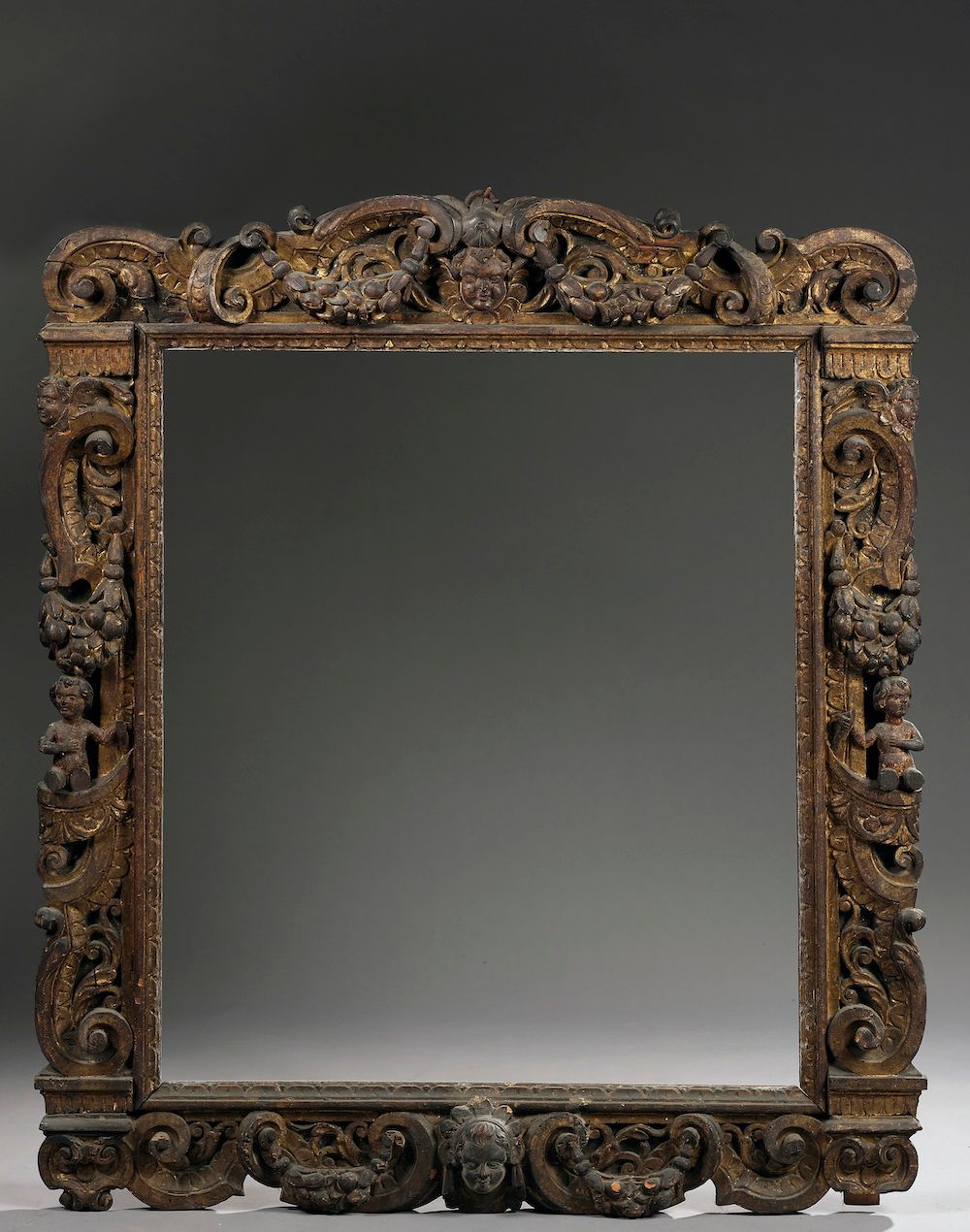
Large "Sansovino style" frame in carved and gilded softwood decorated with scrolls, fruit scraps and putti (some accidents and lacks in particular at the legs of the putti, lower cherub's head probably redone). Northern Italy, Venice, second half of the 16th century. Top. : 120 cm - Width : 101 cm The frame is richly carved in high relief with alternating "cut leather" motifs, scrolled sticks enclosing garlands of flowers and fruit, and putti. The upper part is adorned in its center with a cherub's head between two floral garlands. The so-called "Sansovino style" frames owe their name to the architect and sculptor Jacopo Tatti (1486-1570) who was a pupil of Andrea Contucci del Monte Sansovino. Florentine by birth, he worked in the studio of this great Italian artist, whom he followed to Rome before settling permanently in Venice in 1527. He is credited with creating this type of frame with motifs inspired by Venetian stuccoes, although there is no proof that he was really the initiator. Bibliography : Robert Lodi and Amedeo Montanari, Répertoire du cadre européen, ed. Galleria Roberto Lodi, 2003, a similar model reproduced under n°210 p.112. Expert : Cabinet Laurence Fligny - Mrs Laurence Fligny and Mr Benoît Bertrand - laurencefligny@aol.com - 01 45 48 53 65
Estimate
€5,000 - €8,000
Result
€7,000
Buyer's premium
25%
Large "Sansovino style" frame in carved and gilded softwood decorated with scrolls, fruit scraps and putti (some accidents and lacks in particular at the legs of the putti, lower cherub's head probably redone).
Northern Italy, Venice, second half of the 16th century.
Top. : 120 cm - Width : 101 cm
The frame is richly carved in high relief with alternating "cut leather" motifs, scrolled sticks enclosing garlands of flowers and fruit, and putti. The upper part is adorned in its center with a cherub's head between two floral garlands.
The so-called "Sansovino style" frames owe their name to the architect and sculptor Jacopo Tatti (1486-1570) who was a pupil of Andrea Contucci del Monte Sansovino. Florentine by birth, he worked in the studio of this great Italian artist, whom he followed to Rome before settling permanently in Venice in 1527. He is credited with creating this type of frame with motifs inspired by Venetian stuccoes, although there is no proof that he was really the initiator.
Bibliography :
Robert Lodi and Amedeo Montanari, Répertoire du cadre européen, ed. Galleria Roberto Lodi, 2003, a similar model reproduced under n°210 p.112.
Expert : Cabinet Laurence Fligny - Mrs Laurence Fligny and Mr Benoît Bertrand - laurencefligny@aol.com - 01 45 48 53 65
Sale
Sunday 7 February 2021・13:30 (Europe/Paris)
Sale location coming soon
1 ter, boulevard de la République
92210 Saint-Cloud