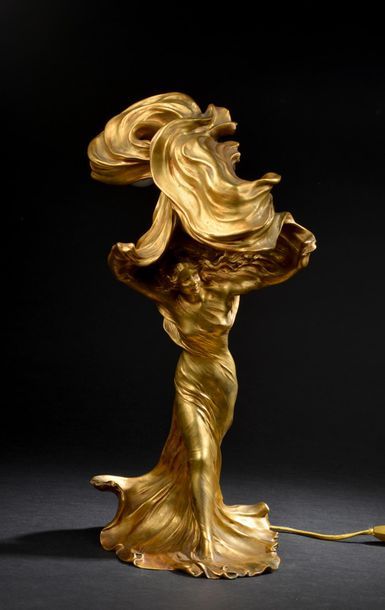
Raoul-François LARCHE (Saint-André-de-Cubzac, 1860 - Paris, 1912). Loie Fuller dancing. Gilt bronze lamp signed on the dress and bearing the Siot foundry stamp - Paris and numbered 936B (light wear). Around 1900. High. Width: 46 cm - Width: 22 cm - Depth: 26 cm. Loïe Fuller (real name Mary Louis Fuller) was born in the United States in 1869. In 1891, this genius choreographer revolutionized her art by creating serpentine dance for her piece Quack Medical Doctor. She mixes animality and electricity, the grace of large fabrics combined with new lighting effects allow her to break with tradition to become an icon. When she arrived in Paris, she settled at the Folies-Bergères for ten years. Great artists, from Toulouse-Lautrec to Carabin, fascinated by her movements, tried to freeze her for eternity. François-Raoul Larche achieved this in 1901 by creating this lamp in homage to Loïe Fuller. She is represented standing, her arms raised, her body sketched by the veil against her skin transforms her into a dream. By making her a lamp, Raoul Larche makes Loïe Fuller the light of this new century, a beacon of the arts and an electrical fairy, a new symbol of Art Nouveau.
Estimate
€10,000 - €15,000
Result
€20,000
Buyer's premium
25%
Raoul-François LARCHE (Saint-André-de-Cubzac, 1860 - Paris, 1912).
Loie Fuller dancing.
Gilt bronze lamp signed on the dress and bearing the Siot foundry stamp - Paris and numbered 936B (light wear).
Around 1900.
High. Width: 46 cm - Width: 22 cm - Depth: 26 cm.
Loïe Fuller (real name Mary Louis Fuller) was born in the United States in 1869. In 1891, this genius choreographer revolutionized her art by creating serpentine dance for her piece Quack Medical Doctor. She mixes animality and electricity, the grace of large fabrics combined with new lighting effects allow her to break with tradition to become an icon. When she arrived in Paris, she settled at the Folies-Bergères for ten years. Great artists, from Toulouse-Lautrec to Carabin, fascinated by her movements, tried to freeze her for eternity. François-Raoul Larche achieved this in 1901 by creating this lamp in homage to Loïe Fuller. She is represented standing, her arms raised, her body sketched by the veil against her skin transforms her into a dream. By making her a lamp, Raoul Larche makes Loïe Fuller the light of this new century, a beacon of the arts and an electrical fairy, a new symbol of Art Nouveau.
Sale
Sunday 1 March 2020・00:00 (Europe/Paris)
Sale location coming soon
1 ter, boulevard de la République
92210 Saint-Cloud